
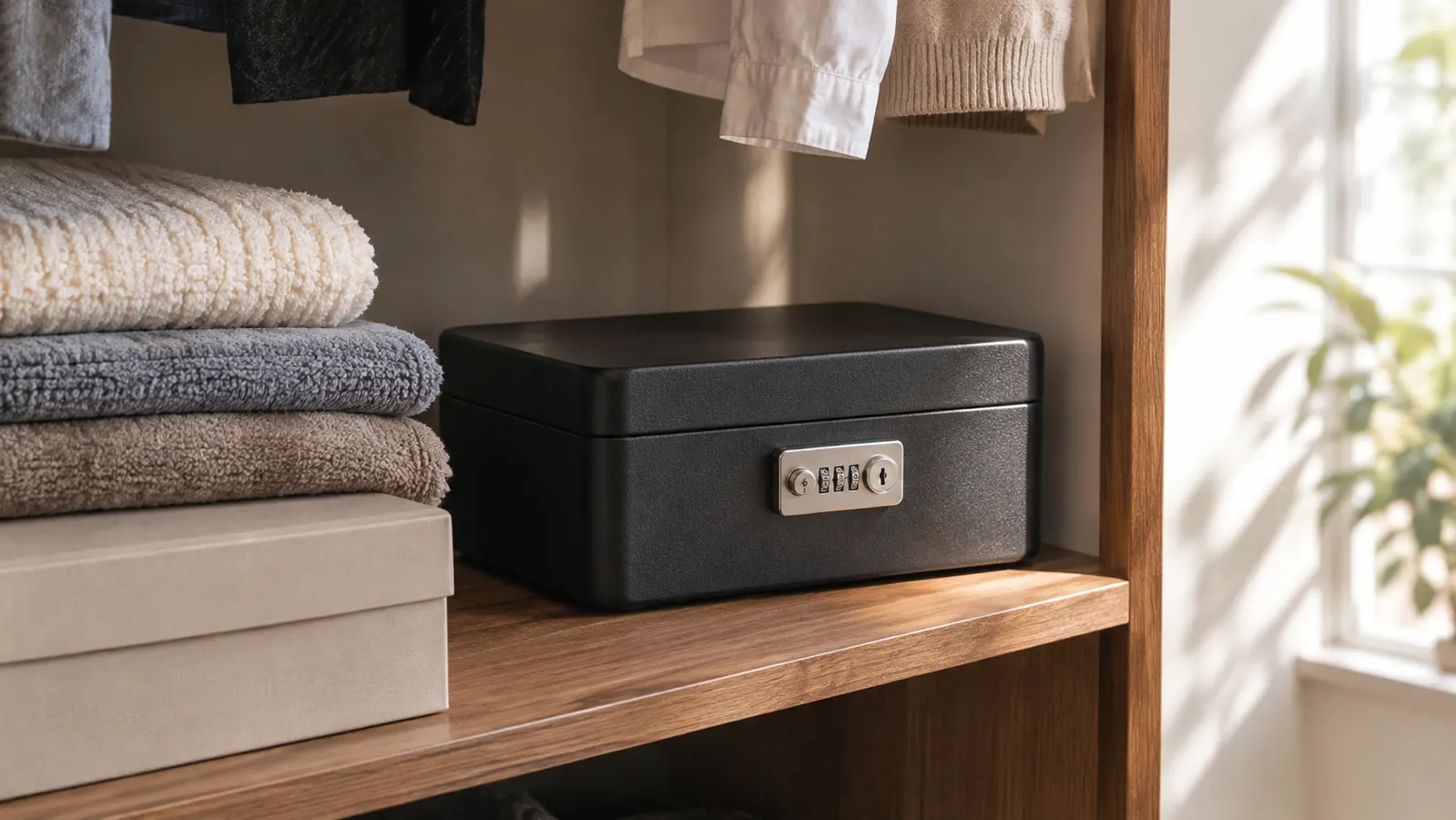
The Master Lock Portable Safe and a small keypad lock box are both sold as ways to protect valuables, but they answer different questions. The Master Lock, model 5900D, is a cable-anchored combination lock box built to leave the house. A small keypad lock box is a fixed box that sits on a shelf or in a drawer. I spent about thirty years as a residential locksmith in Columbus, Ohio, and the failures I saw on house calls rarely involved a lock being picked. More often, the whole box was easy to pick up and carry out. That is the first thing to settle before you compare keypads or steel.
The Master Lock Portable Safe measures 9.31 inches wide, 3.5 inches deep, and 2.25 inches high. It weighs 0.71 kg and gives you 0.08 cubic feet of space, with a chamber 8.13 inches wide, 3.5 inches deep, and 1 inch high. The lock is a resettable four-digit combination on a touchpad. The box also has an audible alarm and water resistance, and it comes with a cable that wraps around a fixed object. A small keypad lock box is the common box with a keypad and a hinged door. It may hold more paper. It does not come with a cable. That single difference decides most of this comparison.
| Master Lock Portable Safe | Small Keypad Lock Box | |
|---|---|---|
| Best use | Travel, hotel rooms, gym bags, cars, pools, and rental stays | A fixed spot at home, such as a closet shelf or desk drawer |
| Anchoring | Cable wraps around a bed frame, pool chair, or car seat rail | No cable, so it sits where you place it |
| Portability | 0.71 kg and 9.31 by 3.5 by 2.25 inches | Meant to stay in one place |
| Capacity | 0.08 cubic feet, with a chamber 8.13 by 3.5 by 1 inches | Usually one deeper cavity for papers and a tray |
| Locking method | Resettable four-digit combination on a touchpad, with no key to carry | Keypad code, often with a keyed override |
| Water resistance | Water resistant | Often not rated for water |
| Alarm | Audible alarm | Usually none |
| Discretion | Cable makes it visible when anchored | Can be tucked into a drawer or behind a sweater |
| Warranty | One year limited warranty | Varies by maker |
| Setup | Set the code, loop the cable, close the lid | Set the code, place the box |
How I Compared Them
I did not try to defeat either lock with tools. I did what a person would do in a hotel room or a spare bedroom. I loaded the Master Lock with a passport, a folded bill, and my father's watch. I looped the cable around a basement shelf leg, closed the lid, spun the four-digit code, and tugged. Then I set the same items in a small keypad lock box and put it in a drawer. The keypad box stayed where I put it. The Master Lock did too, until I picked it up by the cable.
Then I tried the other direction. I set the Master Lock on a bed and lifted it without using the cable. It came up in my hand. That is not a defect. It is the point of a portable box. But it shows you what the cable is for. On a bed frame, a pool chair, or a car seat rail, the cable turns a box you can carry into a box someone has to work at. Without an anchor, it is just a small safe with a case.
I ran the whole test on a Tuesday in March, on my basement bench, with a tape measure and a notebook. The lid opens on a hinge and the chamber is 1 inch high, so I laid the passport flat, set the watch beside it, and the lid closed without pressing on anything. The folded bill slid into the room along the side. When I loaded the same three items into a small keypad lock box, they rattled around in the extra depth until I put a folded cloth underneath to stop it. Deeper is not automatically better. It is better for a stack of paper and worse for a passport you want to grab and go.
The code is the part people ask me about, so I tested that twice. The four-digit combination is resettable, so you set your own and change it later if you want. I set a code, opened and closed the lid twenty times to make sure the touchpad registered every press, then reset it to a second code and ran the same twenty cycles. Both worked. There is no keyhole to pick and no key to lose, which is the whole argument for a combination over a key. I have been called to more houses over a lost drawer key than over a picked lock, and the call is never cheap or quick.
I also checked the everyday details. The touchpad means no key to carry. The audible alarm is there if someone starts messing with the box. The water resistance matters if you take it to a beach, a pool, or a boat. The one year limited warranty is stated plainly. None of that makes it a fire safe. It is a travel lock box, and I judged it as one.
A portable box without a cable is a box you can carry. A portable box with a cable is a box someone has to stop and work at.
Where Master Lock Portable Safe Wins
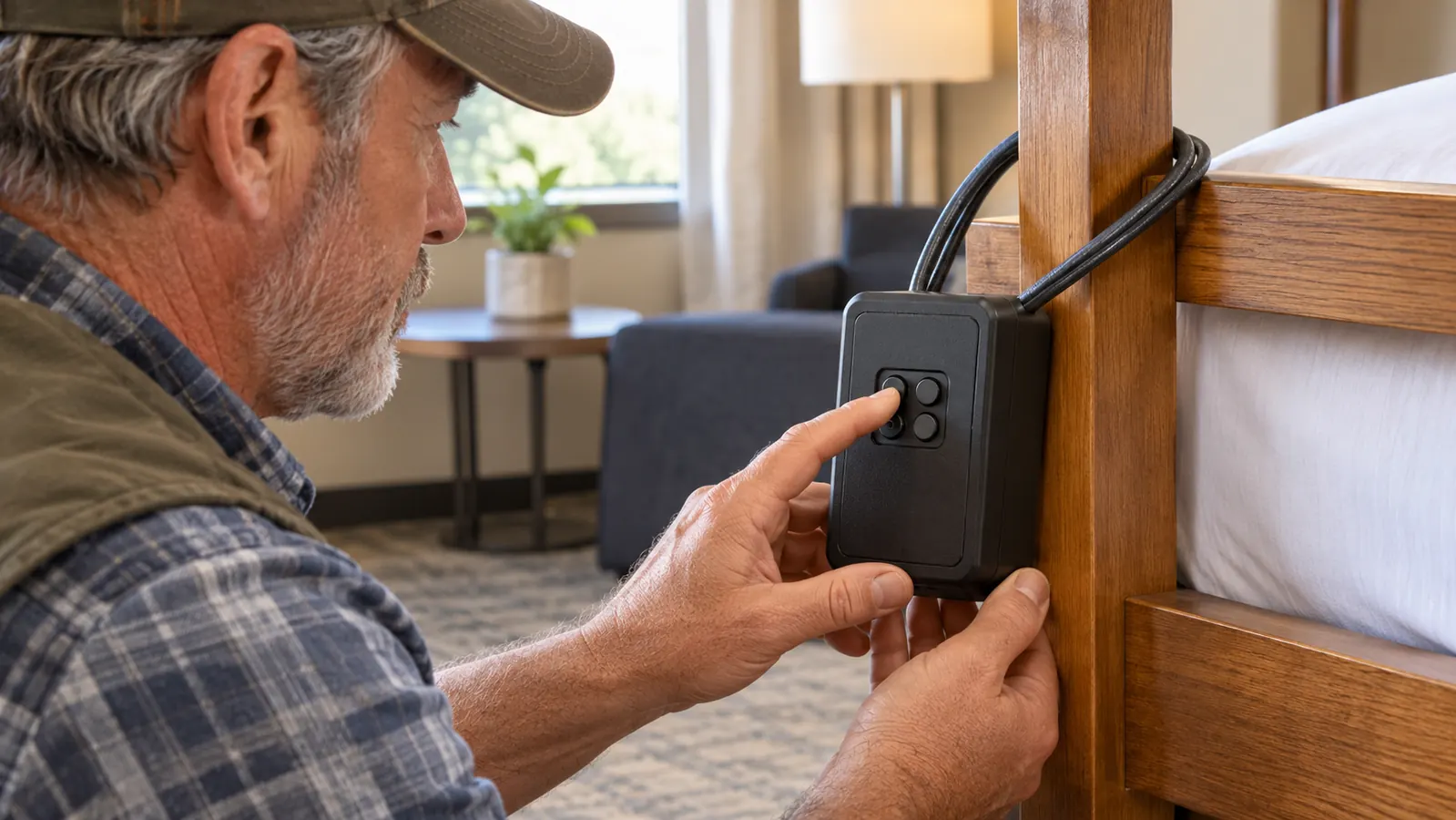
The cable is the feature that changes the outcome. A small keypad lock box has to be carried to be stolen. The Master Lock Portable Safe loops around a bed frame, a pool chair, or a car seat rail. That does not make it impossible to take. A determined person with the right tool and enough time can get through most portable boxes. But it moves the box from the category of easy to carry to the category of a problem. In a hotel room, a rental house, or a gym locker area, that is the difference that matters. The cable is not an accessory. It is the reason the box exists.
I looped it three places to see how the anchor changes the job. Around the leg of a steel shelving unit in my garage, it took one hand and maybe ten seconds. Around the frame of my own bed, I had to lift a mattress corner first, which is the sort of small friction that makes a tired person skip the step entirely. Around the rail of a car seat, it went on in a few seconds and sat out of sight under the seat. An anchor that is awkward will not get used, and an unused cable is the same as no cable. That is worth checking against your own furniture before you buy.
The second win is the combination. A resettable four-digit code on a touchpad means no key to carry, lose, or leave in a jacket pocket. I have seen people hide a key under a mat or in a shoe, which is the same as leaving the box open. The Master Lock keeps the code in your head. The box weighs 0.71 kg and measures 9.31 by 3.5 by 2.25 inches, so it fits in a carry-on, a backpack, or a gym bag without eating the whole bag. The chamber is 8.13 inches wide, 3.5 inches deep, and 1 inch high. That is enough for a passport, a phone, cash, a watch, and a set of keys. It is not enough for a file folder.
The smaller features support the same job. The audible alarm gives you a warning if someone starts working at the box. The water resistance means a splash at the pool or a rainy tailgate is not an instant loss. The one year limited warranty is a normal coverage term for this kind of product. The rating sits at 4.3 stars across more than 16,000 reviews, which tells you the design works for a lot of people in real use. I do not treat reviews as proof of security. I treat them as proof that the lid closes, the code works, and the cable holds. Those are the basics, and the Master Lock covers them.
One thing it will not do: it is not a fire safe and it is not bolted to a floor. If a house fire is your worry, or if you want a box that a burglar cannot walk out with at all, this is the wrong tool and no amount of cable changes that. A cable slows a person down. It does not stop one with a good cutter and five quiet minutes. Buy it for travel, where the alternative is a backpack on a chair, and it does the job well. Buy it expecting a home safe and you will be disappointed by design, not by defect.
Where a Small Keypad Lock Box Wins
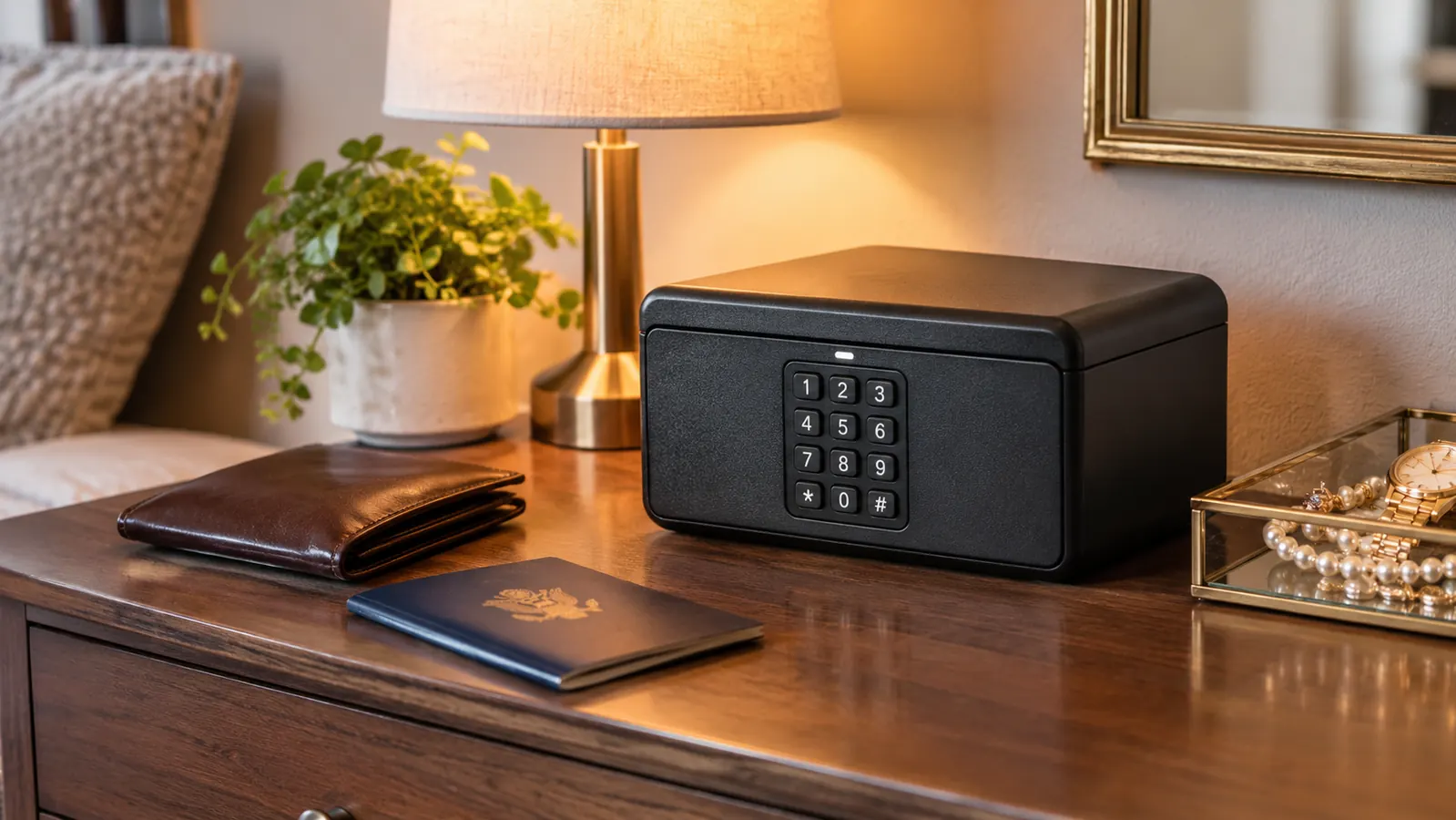
The Master Lock chamber is 1 inch high. That is the honest limitation. If your goal is to keep a stack of papers, a birth certificate, a passport, and a jewelry box in one place, the Master Lock will make you choose. A small keypad lock box is often taller, with a single open cavity that swallows a folder and a jewelry tray. It is not built around a flat stack of travel items. It is built to sit in one spot. For home paper storage, that extra depth is a real advantage, and the Master Lock does not win it. I would not pretend otherwise.
The second win is simplicity at home. A keypad lock box does not need a cable. You set it on a closet shelf or in a desk drawer, close the door, and you are done. There is no anchor to find, no cable to loop, and no need to think about what piece of furniture is sturdy enough. If the box is going to stay in the same room for years, a cable is just something else to dust around. The small keypad box is the lower-friction choice for a fixed spot.
The third win is discretion. A box in a drawer does not advertise itself. The Master Lock has a cable, and a cable has to attach to something. In a hotel room, that is fine. In a guest room or a home office, a cable running to a bed frame is a visible reminder that valuables are nearby. A small keypad lock box can sit under a folded sweater or behind a shoe box. That is not a lock feature. It is a placement advantage, and placement matters.
There is a fourth advantage that does not show up on a spec sheet. A small keypad box can be screwed down or set inside a drawer that already locks, which gives you two layers without any cable at all. It also sits still. You are not unpacking it at every stop, so there is less chance of leaving it on a nightstand in a rental house, which is a mistake I have heard about more than once from people who travel with portable boxes. Both designs ask you to build a habit. The home box asks you to build one habit in one place.
Keep the passport and cash attached to something that will not walk off
The Master Lock Portable Safe model 5900D uses a resettable four-digit code and a cable that loops around a fixed object. It is water resistant, has an audible alarm, and weighs 0.71 kg.
Amazon Check Today's Price on Amazon →Who Should Buy Which
Buy the Master Lock Portable Safe if the valuables leave the house. That means hotel rooms, rental houses, a gym bag, a car, a beach chair, or a poolside table. The cable needs something to wrap around, and travel gives you plenty of anchors. The combination means no key in your pocket. The alarm and water resistance are useful in exactly those places. If you have ever carried a passport and cash in a backpack and felt uneasy about leaving the bag at a table, this is the box that answers that feeling.
Buy a small keypad lock box if the valuables stay home. If you want a box for a closet shelf, a desk drawer, or a bedside table, and you do not plan to carry it, the keypad box gives you more room and less fuss. It will hold papers that the Master Lock chamber will not. It does not need an anchor. It can be tucked out of sight. For a renter who wants a locked drawer for documents, that is often the better fit.
If you are honest about your year, most people need one of these and not both. Count the nights you sleep somewhere other than your own bed. If the answer is a handful, a portable box earns its keep and a drawer box mostly sits empty. If the answer is none, buy the drawer box and put the money you saved toward a proper home safe with a bolt-down kit, because that is the box that actually protects papers from a house fire and from a person with a pry bar. The Master Lock is a travel tool. Use it for travel.
In my own house, I keep important papers and cash in a fixed spot, and I use a portable lock box when I travel. Carol and I have family pieces that do not leave the house, including my father's watch and her mother's rings. Those belong in a fixed safe with a proper anchor, not in a travel box. When we drive down to see our daughter in Cincinnati for a weekend, the travel box goes in the bag and comes back out again. The Master Lock is for the items that have to come with you. A small keypad box is for the items that have to stay put. If you buy for both jobs, you will not ask one box to do work it was not built for.
Take the portable option for the days your valuables leave home
The Master Lock Portable Safe gives you a four-digit combination, a cable anchor, an audible alarm, and water resistance in a box that weighs 0.71 kg. It is built for travel, not for the closet shelf.
Amazon Check Today's Price on Amazon →