
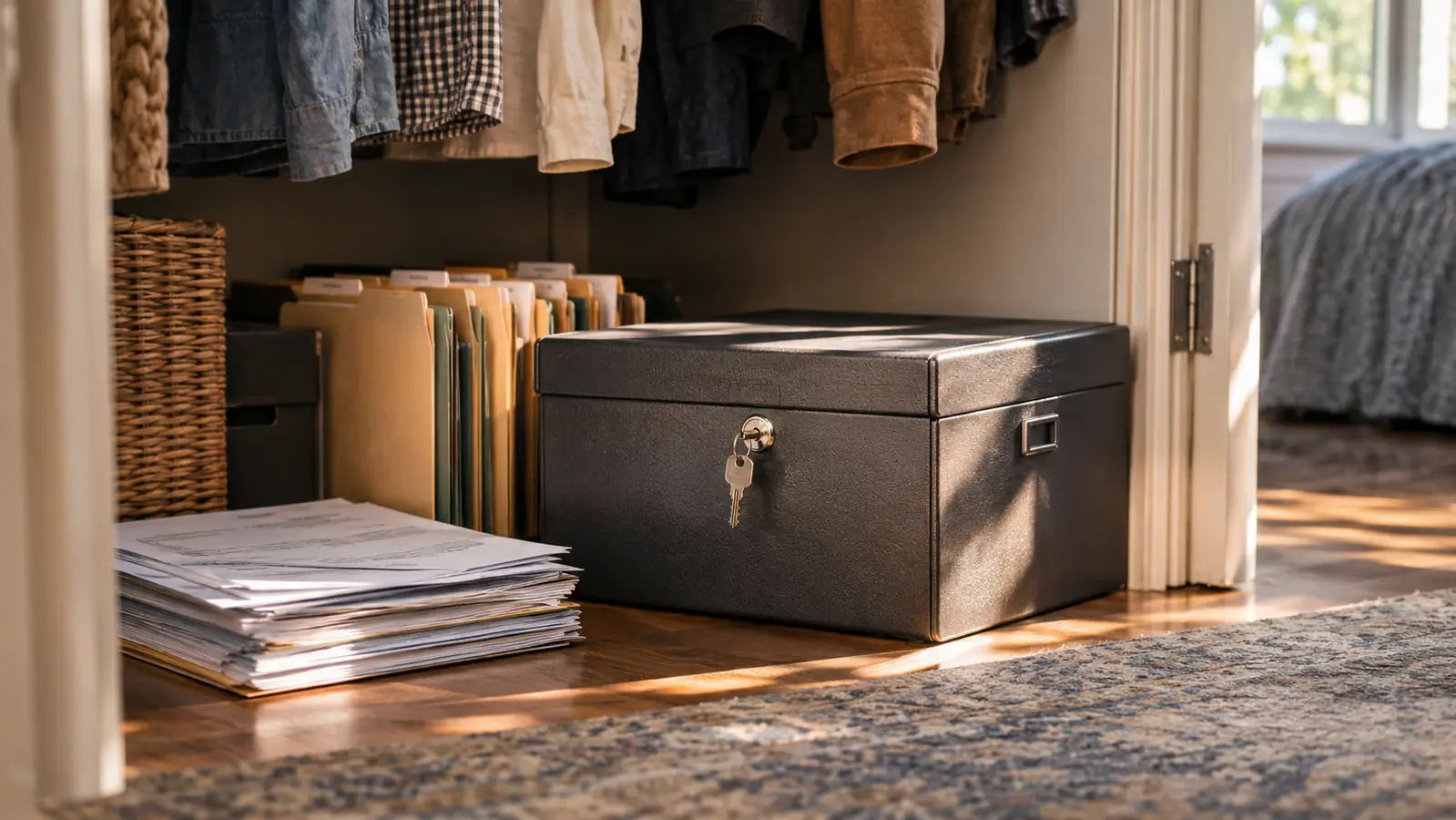
The short answer is that the SentrySafe Fireproof Box and a fireproof document bag solve two different problems, and most people need the box first. I spent about thirty years as a residential locksmith here in Columbus, and I have seen more papers ruined by water and disorganization than by any dramatic burglary. A bag is a good second layer. The SentrySafe box is the layer that does the daily work.
Here is the plain version. The SentrySafe box is a rigid, key-locked container with a UL Classified thirty-minute fire rating, ETL Verified water protection, and enough interior room for hanging file folders. A fireproof document bag is a soft pouch, usually with a zipper, made to hold a flat stack of papers. One is furniture. The other is a carrying case. Neither is a vault, and neither replaces good sense about what you keep at home.
| SentrySafe Fireproof Box | Fireproof Document Bag | |
|---|---|---|
| Fire protection | UL Classified for thirty minutes in high heat. The rigid walls hold their shape. | A fire-resistant fabric pouch. Ratings vary by maker and are often less specific than a UL classification. |
| Water protection | ETL Verified to protect contents during water exposure. | Most bags are not built for standing water. A zipper is a weak point. |
| Capacity and filing | 0.65 cubic feet, 12 inch chamber width, and room for hanging file folders. | A flat stack of papers. No hanging files, no upright filing. |
| Lock and access | Key lock with two keys included. | Usually a zipper. Some have a small lock, but the fabric is the real limit. |
| Portability | 38.8 pounds and 13.5 by 15.5 by 14.3 inches. Movable, but a two-hand job. | Light and flexible. Goes into a backpack or a go bag. |
| Footprint | Needs floor space in a closet, office, or under a desk. | Slides behind a dresser or into a drawer. |
| Everyday access | You need the key to open it. That is the point, but it is slower. | Unzips in a second. |
| Organization | Rigid interior keeps papers upright and small items from sliding into a pile. | Soft sides let contents shift. |
| Best for | Passports, birth certificates, insurance records, cash, and small keepsakes in one place. | A few copies you can grab on the way out. |
Where the SentrySafe Box Wins
The SentrySafe box wins on the things that matter for a home file. It stands up. Literally. You can put hanging file folders inside, close the lid, and the papers stay upright instead of sliding into a heap. The interior chamber is 12 inches wide, which is the number that lets standard hanging folders fit. If you have ever opened a soft bag after six months and found every document curled at the bottom, you know why that matters.
It also wins on water and access control. The ETL verification for water exposure is not a marketing phrase I take lightly. I have seen a basement flood turn a cardboard box of tax records into a brick of pulp. One call still sits with me: papers kept in a plastic tote on a low shelf, the shelf sitting two inches above the water line, and it made no difference at all, because the water came up through the floor slab and the tote filled from underneath. A sealed rigid container buys you what a tote cannot. The SentrySafe box has a key lock and two keys, so the papers are not just protected from fire and water, they are also behind a lock. It is not a bank vault. A determined person can pick it up and carry it out. But for the ordinary household, the lock is enough to keep a curious teenager or a nosy houseguest out of your passport folder. SentrySafe also backs the box with a one year limited warranty.
Where the Document Bag Wins
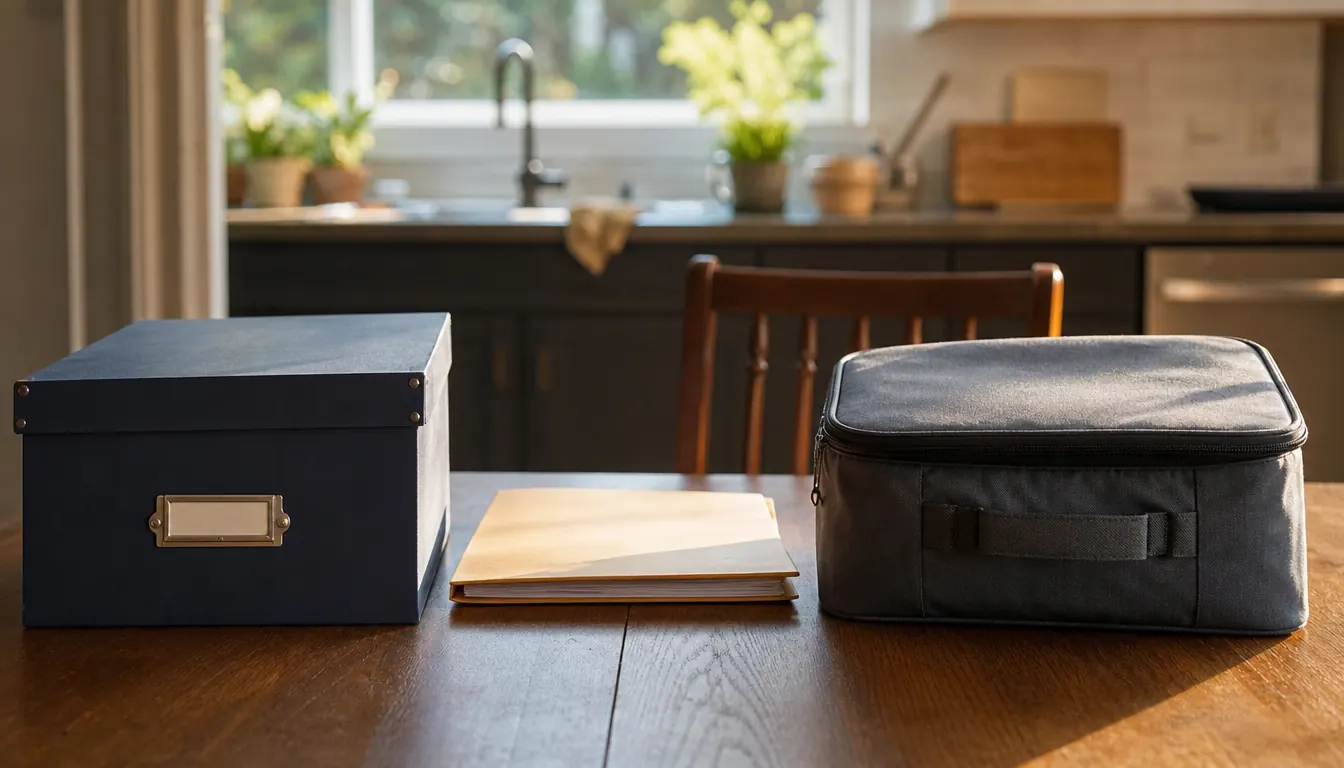
The document bag wins the grab-and-go test, and that is not a small thing. It is light. It is flexible. It slides behind a dresser, into a backpack, or into the bottom of a go bag. If you need to take copies of your insurance policy to an appointment, the bag is easier than moving a 38.8 pound box from the floor. The bag also wins on footprint. In a small apartment, a soft pouch can live in a drawer where a rigid box would be in the way.
It wins on everyday access too. A zipper opens in a second. The SentrySafe box needs a key, and if you are like me, the key is not always on the hook where it belongs. That is not a reason to skip the lock. It is a reason to be honest about the trade. The bag is the thing you grab when you are in a hurry. The box is the thing that stays put and holds the originals.
The box that does the everyday work
If you want your passports, insurance records, and the watch your father left you in one rigid, locked place, the SentrySafe box is the one I would start with. It has a UL Classified thirty-minute fire rating, ETL Verified water protection, and a key lock with two keys.
Amazon Check Today's Price on Amazon →What the Fire Rating Actually Means
A UL Classified thirty-minute rating is a real test, not a sticker someone printed in a garage. It means the container was tested in a furnace that follows a standard time and temperature curve, and the inside stayed cool enough for paper for thirty minutes. That curve climbs hard in the first few minutes, which is why the clock starts at ignition and not when the fire gets big. In the summaries I have read over the years, the weak point on most boxes is the lid seal, not the walls. That is the entire promise. Thirty minutes. Not thirty hours. Not forever. A house fire can burn hotter and longer than the test, and a box that falls through a floor into the basement is in a different situation than a box on a closet floor.
I explain it to people this way. The rating buys you time. It does not buy you a guarantee. If the fire department is three minutes away, thirty minutes is plenty. If you live down a long country road with a volunteer department, it is still better than a cardboard file box, but it is not magic. The SentrySafe box also has ETL verification for water exposure, which is the part most people forget. Fire gets the attention. Water does the quiet damage.
The document bag has a rating too, but the ratings vary more from maker to maker. Some bags are tested to a standard and print the details. Some print a temperature and no time. Some print nothing at all. I would not buy a bag without a clear label. The same goes for a box. A fireproof container without a rating is a plastic tub with a nice adjective on the box.
The Water Test and the Basement Floor
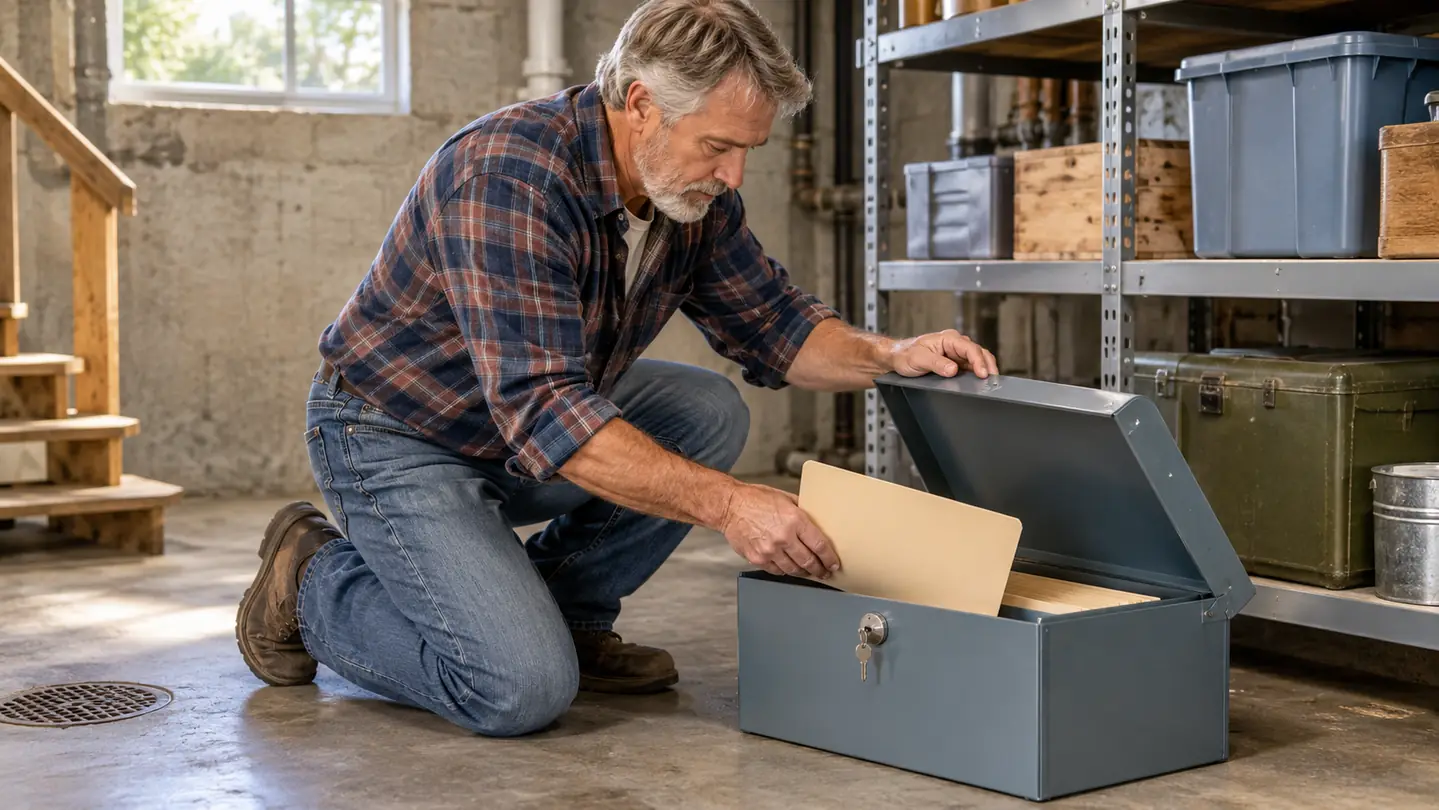
I tested the SentrySafe box in my own basement, on the concrete floor near the floor drain. It was the second week of March, the wettest stretch we had that year, and the drain had already backed up once that month. I put a folded paper towel inside, closed the lid, and left it there through a wet week. I checked it on the Tuesday morning and again that Friday afternoon. Dry both times. I also set the box on a scrap of two-by-four the first night to see whether the lid seated flat, then took the board out, because the floor mount is the whole point and a box that rocks is a box that lets water creep. That is not a laboratory test. It is the kind of test a homeowner can actually do. The ETL verification is the formal part. My paper towel is the part that made me trust it in my own house.
The bag is a different story. A good bag can keep rain off a document, but it is not a rigid container. If water gets into the room and the bag is lying on the floor, the zipper is the weak point. If the bag is floating in a flooded basement, the seams are the weak point. Some bags claim water resistance. Few claim water protection for a period of time. Read the label. If the bag does not state a water rating, treat it as a rain cover, not a flood cover.
This is why I keep the SentrySafe box on the basement floor and not on a shelf. The specs list it as a floor mount, and the weight makes it stable. It is 38.8 pounds. It is not going to slide around when someone bumps it. A heavy box on the floor is harder to knock over than a bag on a shelf.
The rating buys you time. It does not buy you a guarantee.
The Lock, the Keys, and My Own Bad Habit
The SentrySafe box comes with two keys. That sounds like a small detail until you lose the first one. I keep one key on a hook in the basement and one in the kitchen drawer, and years back I had a third cut at the hardware store on Hardy Road that lives in a coffee can on the garage bench. Three keys for one box sounds like too much until you are standing in front of it at seven in the morning with a folder of papers in one hand and no key in the other. The lock is a privacy key lock, which is exactly what it sounds like. It keeps honest people honest. It keeps a curious houseguest out of your passport folder. It will not stop a determined thief with a crowbar and time.
A document bag usually has a zipper and sometimes a small luggage lock. That is not access control. It is a delay. If someone wants what is inside, the fabric gives way before the lock does. If your goal is to keep a child from pulling out a birth certificate, the bag is fine. If your goal is to keep a cleaning crew or a houseguest from going through your papers, the SentrySafe box is the better answer.
I will say one thing against my own habit. A lock is only useful if you use it. I have seen people buy a fireproof box and then leave the key in the lock. I have done it myself. The box is still heavy and still rated, but the lock is doing nothing. Put the second key somewhere you will remember, and keep the first one with you. That is not a product flaw. That is a people flaw.
What I'd Skip
I would skip any fireproof container that does not print a rating. I would skip a document bag as the only protection for original birth certificates, passports, and insurance policies. I would skip a box that is too small to hold a hanging file folder, because a pile of papers in a small box is just a pile of papers with a lid. The SentrySafe box fits hanging folders, has a 0.65 cubic foot capacity, and has a 12 inch chamber width. That is the size that works for a household file.
I would also skip the idea that one container solves everything. The bag and the box are not enemies. The box holds the originals. The bag holds copies you can grab. My daughter in Cincinnati has a copy of our will, and a bag is a reasonable way to carry a copy like that. If you keep your father's watch and Carol's mother's rings in the same closet, the box is the better home. The bag cannot protect a watch from a falling beam. The box can at least give it a chance.
Who Should Buy Which
Buy the SentrySafe box if you have a drawer or a closet floor where papers live and you want them in one locked, rated place. Buy it if you have passports, birth certificates, insurance records, a little cash, and a couple of small keepsakes. Buy it if you want hanging file folders to stay upright and you want a key lock with two keys. That is the ordinary homeowner case, and it is the case I see most often.
Buy the document bag if you already have a box and you want a grab-and-go copy for travel or for a quick exit. Buy it if you live in a small apartment and a rigid box would be in the way. Do not buy it as your only fire protection for the papers you cannot replace. If you can only buy one, buy the SentrySafe box first. Add the bag later if you want a second layer.
Start with the container that stays put
A document bag is a supplement. The SentrySafe box is the base. Put the papers that would be hard to replace behind a key lock and a rated wall, then decide if you want a grab-and-go bag for copies.
Amazon Check Today's Price on Amazon →