
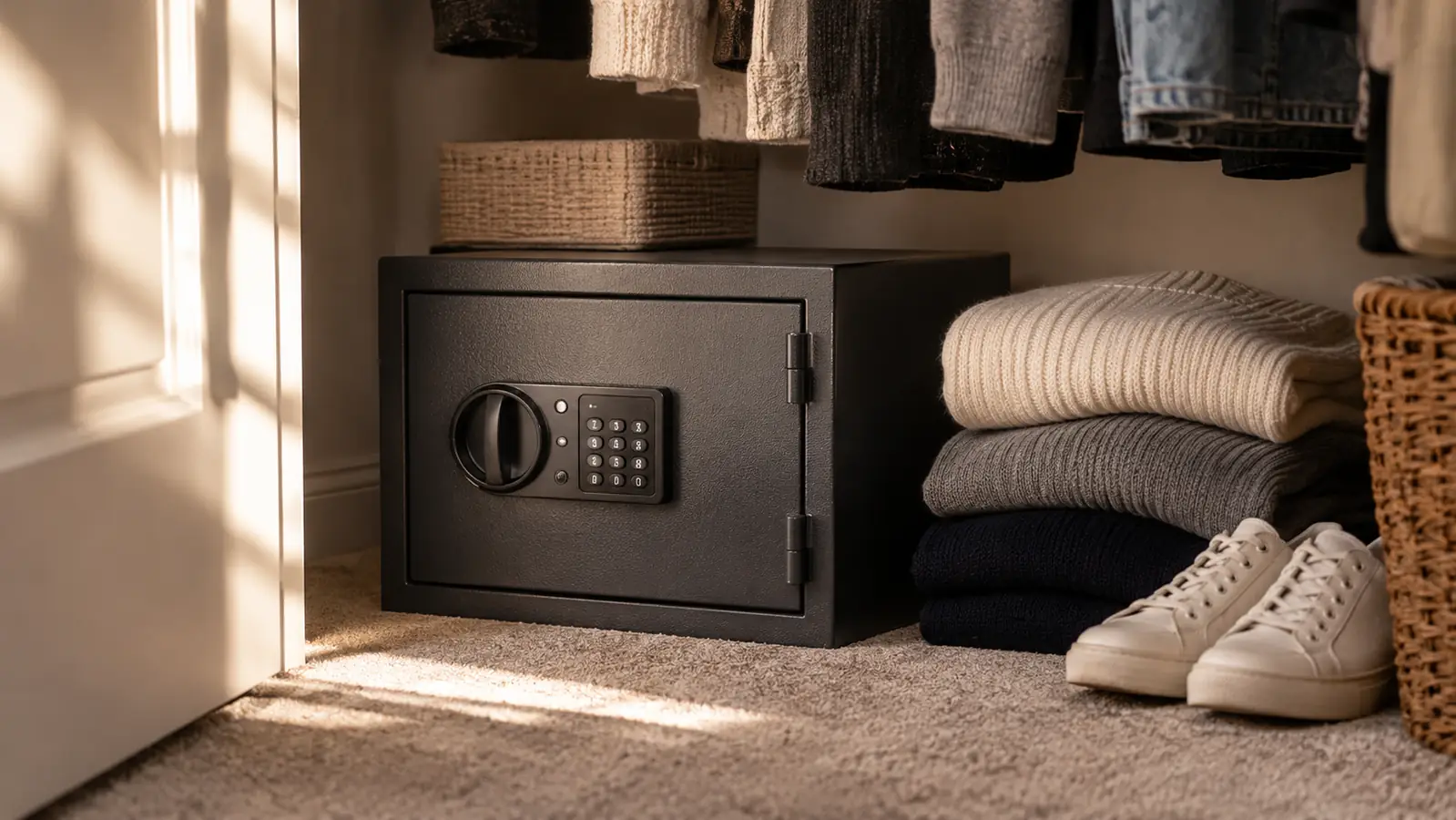
Most people buy a small home safe right after something makes them nervous, and I don't blame them for that. I spent about thirty years as a residential locksmith here in Columbus, Ohio, and I opened more of these boxes than I can count. Nearly every one of those house calls was somebody who had lost a key, forgotten a code, or inherited a safe with no instructions at all. So I have opinions about which ones are worth bolting to a floor, and which ones are a locked shoebox with a battery in it.
The TIGERKING 20 lb biometric safe has been bolted to the floor of my bedroom closet for the better part of a year. It holds a folder of household paperwork, an envelope of cash, my father's watch, and Carol's mother's rings. What follows is my long-term notes on the thing: how the fingerprint reader has behaved, what 1.2 cubic feet actually swallows, how the mounting went, and the places where this box stops being the right tool for the job.
The Quick Verdict
A genuinely solid small safe with a reader that has opened on the first try for both of us. Buy it for papers, cash and jewelry that you want behind a finger instead of a key. Do not buy it expecting fire protection, because there isn't any.
Amazon Check Today's Price →The Small Bolted Box That Lives in My Closet
Fingerprint access, a combination backup, two emergency keys, and four expansion bolts in the box so it goes into the floor the day it arrives. See the current listing and today's price on Amazon.
Amazon Check Today's Price on Amazon →How I've Used It
I open this safe five or six times a week, which is more than most people ever will. Carol is in it for her rings on Sunday mornings. I am in it for the paperwork whenever a bill wants a birth date or a policy number off an old document. That routine is worth more than any single torture test I could run on a workbench, because a safe you avoid opening is a safe you quietly stop locking. The reader has to be faster than the drawer the items used to live in, or the whole thing loses.
On that count it has held up. I put my right index finger in and the door is open before I have finished deciding to open it. Carol, who is more skeptical of anything with a circuit board in it, took to it faster than she took to the keyed lockbox it replaced. Neither of us has been locked out. I want to be careful with that claim, because a year is not ten years, and I have replaced plenty of failed readers on other people's safes. What I can say is that in roughly twelve months of real use, this one has not once made me go find the keys.
Here is the ordinary test that told me more than any bench measurement could. A Tuesday in March, a letter from the county about a property line, and a request for a document I had not looked at in years. The old version of that errand was twenty minutes of pulling down boxes in the basement, and I know that because I did it that way for two decades. This time I walked into the closet, put a finger on the reader, lifted the shelf out with the papers already stacked on it, and had the thing in my hand in under a minute. I put it back the same way. That is the entire pitch for a small safe in a bedroom closet, and it is also why an unmounted box in a basement corner never gets used.
The body is 20 pounds of alloy steel with a 50 mm door face and two 25 mm locking bolts. That is a real step up from the pressed tin boxes sold in the impulse aisle, and I want to be plain about what it is not. It is not a burglary safe. A determined person with a pry bar and five undisturbed minutes will get into almost anything in this size class, and no honest locksmith will tell you otherwise. What a box like this does is remove the easy version of the crime, the one where somebody walks in, picks something up, and walks out.
What 1.2 Cubic Feet Actually Holds
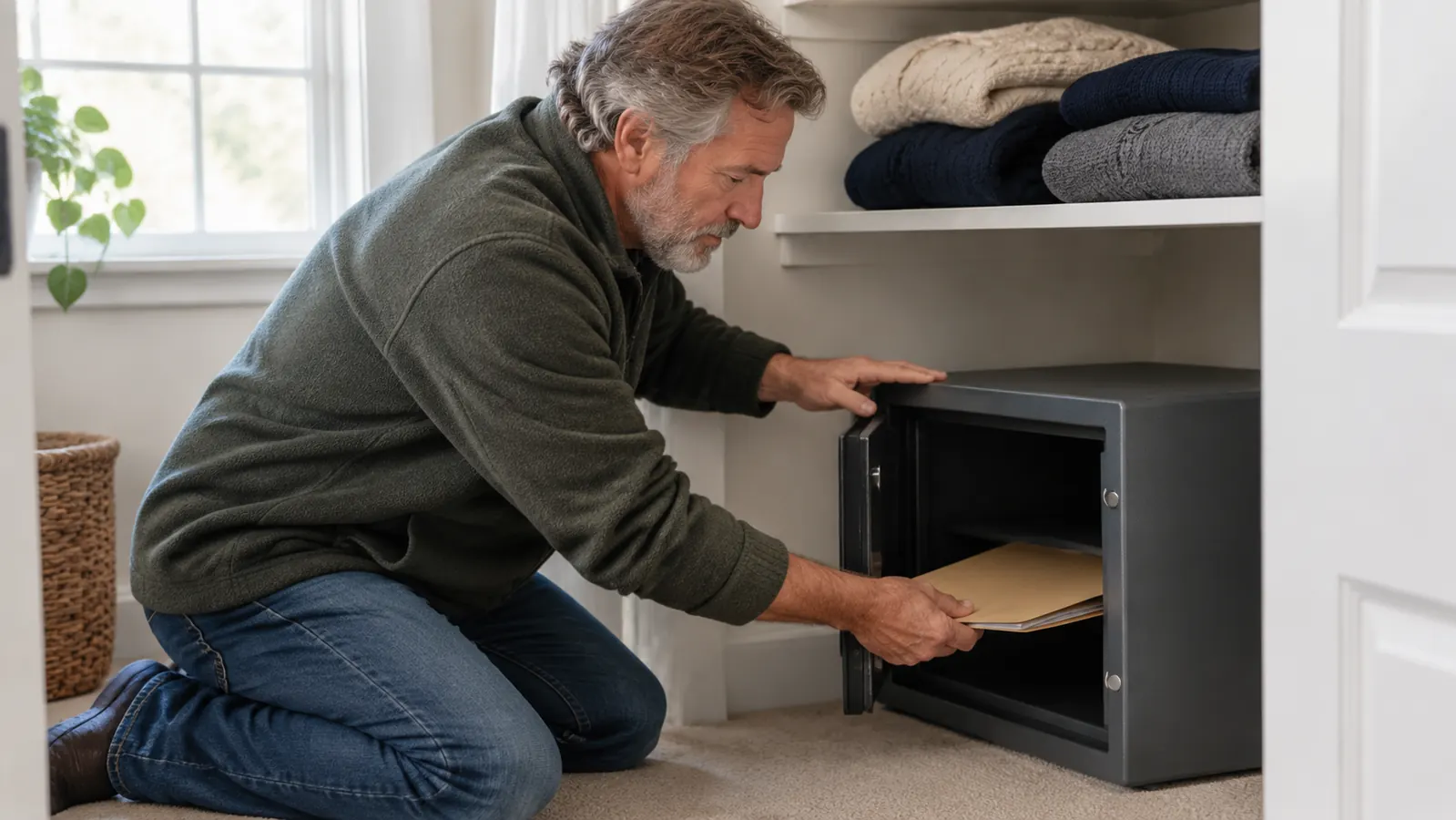
The exterior measures 9.9 inches deep, 13.8 inches wide and 9.9 inches high, so this is a wide, low box rather than a tall cabinet. Inside, with the removable shelf dropped in, you get two shallow compartments. That arrangement suits the job it was built for: rings, a watch, passports, a title, an envelope of cash, a thumb drive or two. Carol's mother's rings sit on the shelf where she can see them the second the door swings. The paperwork goes underneath.
To give you something concrete, here is what is in mine right now. A stack of household papers about two inches thick in a manila folder. A padded envelope with cash. Two passports in a plastic sleeve. My father's watch in a small case. Carol's mother's rings in the velvet box they came in. A thumb drive. The TIGERKING shelf sits above the folder when everything is arranged, and everything is arranged, which matters more than people think. What did not fit: a three-inch binder of old tax returns I tried to put in during the first week. The shelf would not drop back into place, the door would not close without pressure, and I gave up and carried the binder back to the basement where it belongs. Measure your stack before you order.
What it will not do is swallow a file box. A folder of documents goes in as a stack, not as a hanging file, and once you add a thick binder you are negotiating. This is the single most common disappointment I hear about small safes, and it is not the manufacturer's fault. People picture the drawer they are emptying and assume the safe matches. Measure the stack first. If your stack is more than a couple of inches thick, buy the next size up and thank yourself later.
The Lock: Fingerprints, Codes, and Two Emergency Keys
The reader is the part everyone asks about, so here is how it behaves in the real world. Dry winter hands are the usual killer for cheap biometric sensors, and central Ohio in February is about as dry as it gets. This one has still read my finger on the first press. I enrolled both index fingers and Carol enrolled hers, and it recognizes each of us without any fiddling or wiping the sensor first. It does not love a wet hand, though. Come in from the garden with damp fingers and you will press twice.
Setting it up took one pass through the manual and about ten minutes. You enroll a finger by pressing it on the reader several times in a row, which is the routine every biometric reader I have handled uses. I did my right index and my left index, then had Carol do her right. I set a combination code the same afternoon and wrote nothing down, which I would not recommend to anybody. If you take one thing from a man who spent three decades being paid to open other people's boxes, it is this: write the code down and keep it somewhere outside the house. A safe you cannot open is just a very sturdy box.
That is where the backup matters, and this safe has two of them. There is a combination code, and there are two emergency keys in the box. In thirty years of house calls, the number of people I drilled into because a reader quit or a code was forgotten is not small, and every one of them would have given a great deal for a key they had put somewhere sensible. Put the emergency keys somewhere sensible. Not in the closet next to the safe. That defeats the entire exercise, and yes, I have seen that too.
The vibration alarm is the feature I get asked about least and mention most. It is a local noisemaker, not a monitored system, and it will not bring anybody running from three streets away. What it does is make a quiet, private act suddenly loud, and that is most of the deterrent value of a box like this. Somebody who thinks they are working in silence and is suddenly not tends to leave.
Twenty pounds of alloy steel on two 25 mm bolts will not stop a professional. It stops the version of this crime that actually happens, which is somebody walking out with your box under one arm.
Mounting It Is the Whole Job
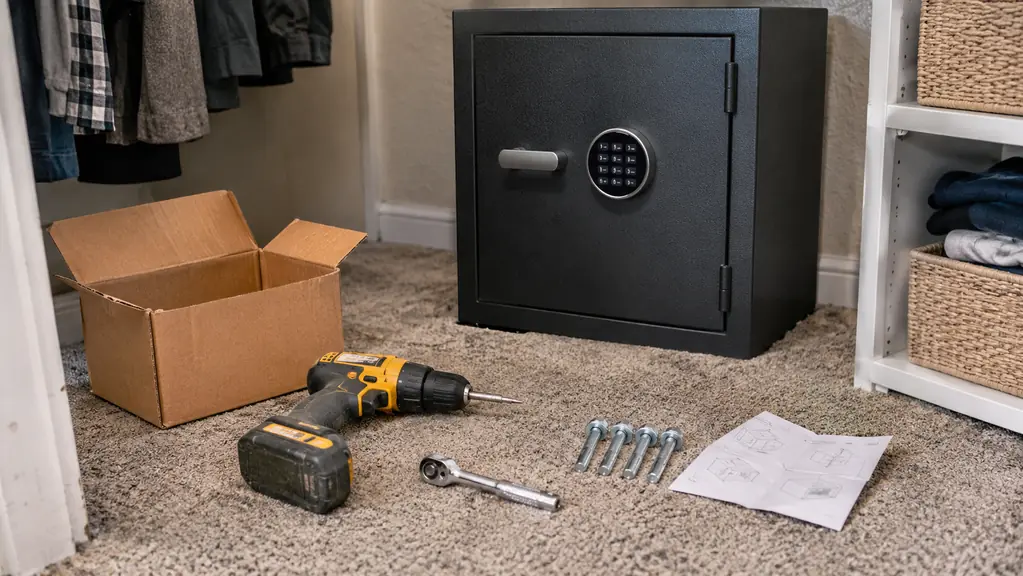
An unmounted safe of this size is not a safe, it is a heavy lunchbox. Twenty pounds rides under one arm very comfortably, and a burglar who cannot open a box in ninety seconds will simply take it home and open it at leisure. The TIGERKING box has pre-drilled holes in the back panel and the bottom, and four expansion bolts come in the carton. I went through the bottom into my closet floor, which took me about twenty minutes with a drill and a socket wrench, most of it spent clearing Carol's sweaters out of the way.
I did the job on a Saturday morning with a cordless drill, a bit matched to the bolts, and a socket wrench, and I want to describe the order because the order matters. Sweaters out first. Then the safe set on the floor where I wanted it, then a pencil line traced around the base so I could not talk myself into shifting it halfway through. I drilled the two front holes, then leaned in and checked for the joist before drilling the back two. My first instinct was to bolt through the back panel into the closet wall, which would have been quicker and would have looked tidier, and I talked myself out of it. A wall in a two-story Ohio house is mostly drywall and air, and drywall holds nothing. The floor went through structure. Four bolts, and I checked each one twice with the wrench before the sweaters went back.
Two things I would tell anyone doing this. First, find the joist or use a proper anchor, because expansion bolts into a hollow floor and expansion bolts into structure are two different levels of security. Second, mount it where you will actually use it, not where it looks tidiest. A safe in a damp basement that you visit twice a year has become a time capsule. Mine is in the bedroom closet because that is where the papers already lived.
Where It Falls Short
No fire rating. I want that in bold, and I cannot put it in bold, so read it twice. Nothing in this listing claims a fire rating and the box does not have one. Paper starts to char well below the temperatures a house fire reaches in a closed room, and a steel box with no insulation behaves like an oven. If your reason for buying a safe is a birth certificate, a deed, or a life insurance policy you may need to produce after a disaster, keep those in a fire-rated document box or a bank box. This safe is for theft and casual loss, not fire.
Beyond that, the honest gripes are small. The 1.2 cubic foot capacity fills faster than anyone expects. The reader does not like wet or muddy hands. The alarm is loud in a closet and probably inaudible from the far end of a large house. And the low, wide shape means you are reaching down and forward rather than standing upright, which is fine at my age and will be less fine at eighty. None of those are defects. They are the trade you make for a box this size.
What I Liked
- The fingerprint reader has opened on the first press for both of us through a full year, including dry winter hands
- Four expansion bolts and pre-drilled back and bottom holes mean it can be anchored the day it arrives
- A combination code plus two emergency keys means a dead reader is an annoyance rather than a locksmith bill
- 20 pounds of alloy steel with a 50 mm door and two 25 mm bolts gives it real heft for the size
- The removable shelf separates jewelry from paperwork cleanly
Where It Falls Short
- No fire rating of any kind, so it will not protect paper from a house fire
- 1.2 cubic feet goes fast once a folder goes in
- The vibration alarm is a local noisemaker, not a monitored alarm
- The reader is fussy about wet or muddy hands
- The low, wide shape means reaching down and forward every time
Who This Is For
This is for the household that has a modest amount of value sitting in a sock drawer and wants it behind a finger instead of a key. Renters, because the four bolts come out of a wood floor and the holes patch with a little putty. People who lose keys, which is most of us eventually. People who want in and out in two seconds on a Sunday morning rather than a combination dial in the dark. If that describes you, the TIGERKING box does the job it was built to do, and it does it without asking much of you.
Who Should Skip It
Skip it if your main worry is fire, because it offers no protection there and I will not pretend otherwise. Skip it if you have a genuine pile to store, because 1.2 cubic feet will insult you by the second week. Skip it if you will not bolt it down, since an unbolted box is a gift with a handle. And skip it if what you actually want is a gun safe, because this is not that and never will be. For the longer argument on readers versus keypads, I keep a separate write-up on biometric safes against keypad safes, and a plain list of what a fingerprint box buys you over a key. Read those before you spend anything.
If a Small Bolted Box Is Honestly What You Need
Fingerprint access, a combination backup, two emergency keys, a removable shelf, and a vibration alarm, in a 1.2 cubic foot alloy steel body that anchors to the floor. Check today's price and see whether it still fits what you are trying to protect.
Amazon Check Today's Price on Amazon →