
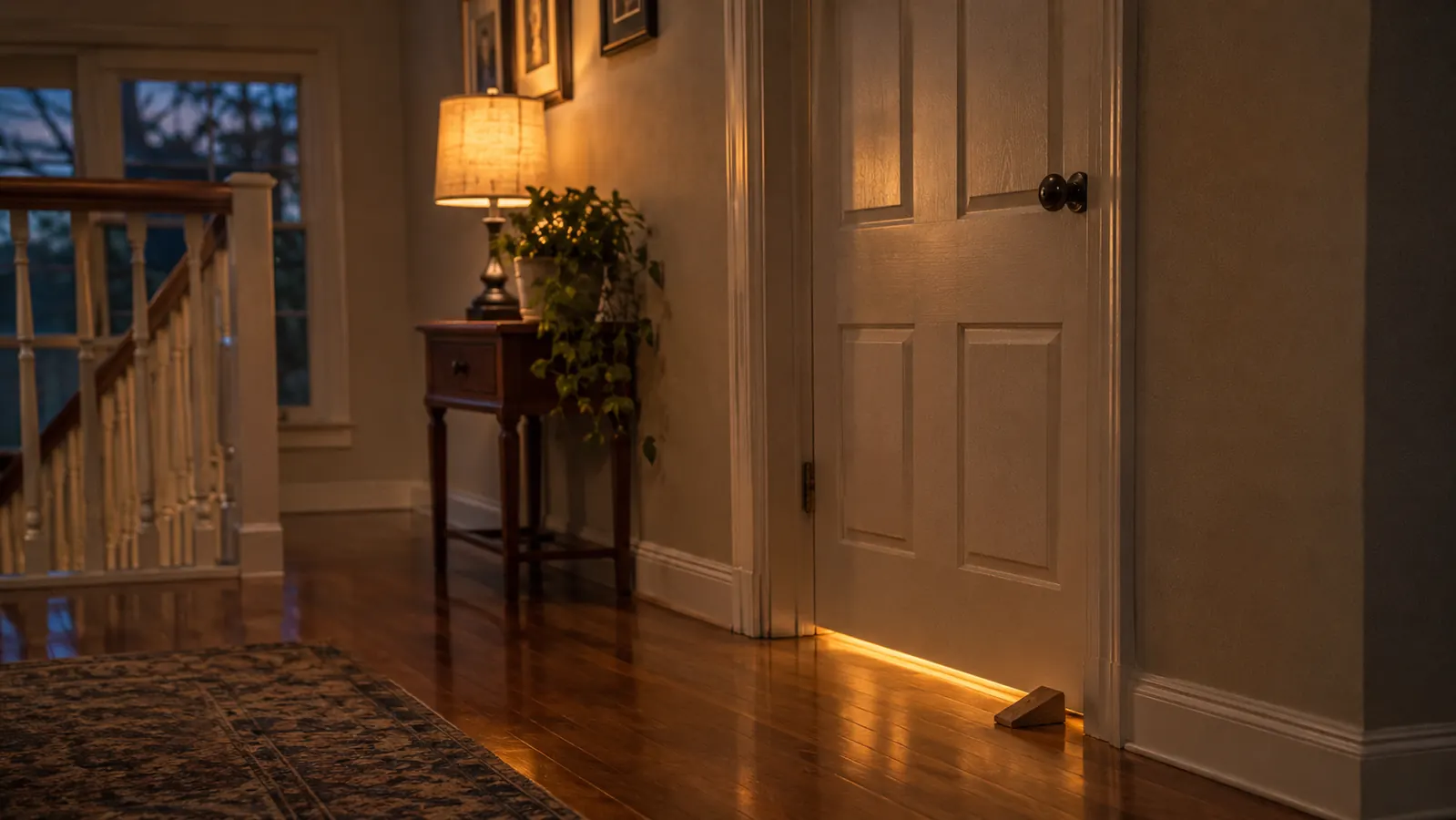
Every home security pitch I hear starts the same way: a contract, an installer, a panel in the hallway and a monthly charge. Thirty years of locksmith work taught me something less sellable. The parts of a house that actually get tested are the small ones, and the cheapest piece of hardware in the room is usually the piece that makes the noise.
That is where the SABRE door stop alarm comes in. It is a wedge. You push it under a closed door, the pad on the bottom bites the floor, and the moment someone puts pressure on the door from the other side, a 120 decibel siren fires. No wiring, no hub, one 9 volt battery, 4.8 ounces. That is the entire product. Here is why I keep them in my own house and why I would hand one to my daughter in Cincinnati tomorrow.
The Cheapest Layer of Home Security Fits Under a Door
SABRE door stop alarm: 120 dB siren, non-skid pad, one 9 volt battery, no wiring and nothing screwed into a frame. Set it, test it monthly, leave it there.
Amazon Check Today's Price on Amazon →It turns a closed door into a trigger, not just an obstacle
A plain door stop is passive. This one has a sensor in it. SABRE builds a contact trigger into the wedge, so the instant the door puts pressure on it, the 120 dB siren goes off. In practical terms: someone tries the knob, the door gives a fraction of an inch, and the hallway fills with noise. That fraction of an inch is the whole idea. You are not so much stopping the door as making sure nobody gets to open it quietly.
The non-skid pad does the quiet half of the job
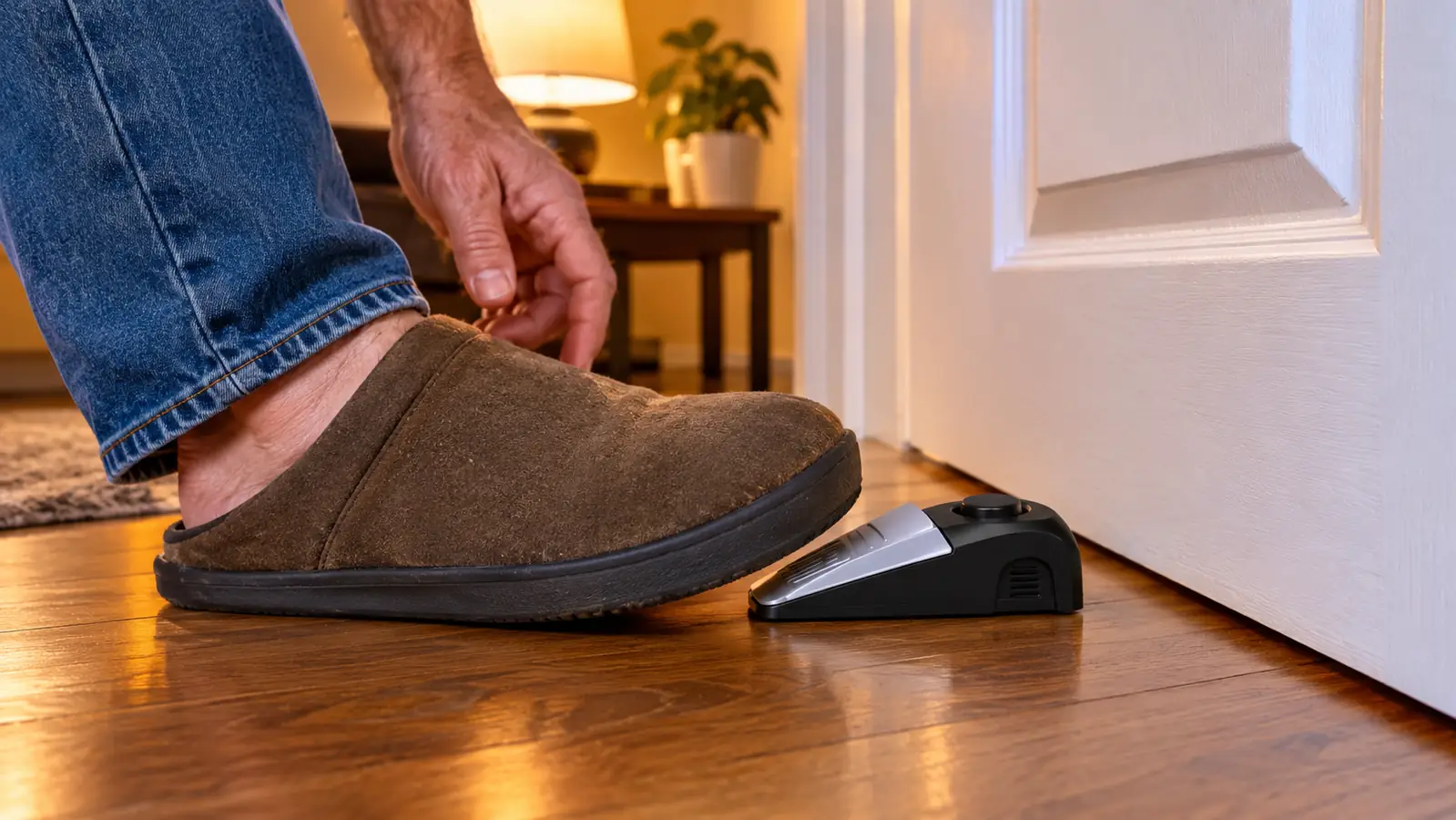
Half of what this thing does makes no sound at all. The non-skid pad on the bottom grips the floor and holds the door from swinging inward while the alarm is already screaming. That matters more than people expect. A loud alarm with a door that still opens is a nuisance. A loud alarm with a door that will not budge is a real problem for whoever is standing on the other side of it. SABRE lists it for doors with a gap of about seven-eighths of an inch.
120 decibels reads as something wrong, not something beeping
120 dB is not a polite chirp. It sits in the neighborhood of a chainsaw or a loud concert, and in a stairwell with hard floors it does not sound like a home gadget. It sounds like an emergency. That is the point of the number. You want the noise unpleasant enough that whoever set it off wants to be somewhere else, and loud enough that you come awake from the far end of a two-story house with the basement door shut.
Rated audible up to 600 feet, which is a neighbor's problem too
SABRE rates the siren audible up to 600 feet. I cannot verify that from my basement and I would not build a security plan on a number printed on a box. What I can tell you is why the number matters in a house. Most break-ins that get interrupted are interrupted by somebody other than the homeowner: a neighbor, a passerby, a dog walker. A siren that carries past your own walls is doing work that a siren confined to one room is not.
Ten seconds to set up, one small screwdriver for the battery
There is no wiring and no installation. You open the battery compartment with a small screwdriver, drop in one 9 volt alkaline battery, and close it back up. Then you set the wedge on the floor and push it under the door with your foot. The whole job takes about as long as reading this entry. Nothing gets drilled, nothing gets screwed into a frame, and nothing has to be undone when you move out.
Renters can use it without asking anyone's permission
Renters get the worst of home security. You cannot swap the deadbolt, you cannot drill the frame, and the landlord does not want the conversation. This is one of the few pieces of hardware that sits on the floor and touches nothing permanent. When the lease ends, it goes in a drawer at the next place. It is also the one item I would tell a college student to take to an apartment, because it needs nobody's approval and it works the first night.
It disappears into a duffel for hotels and rentals
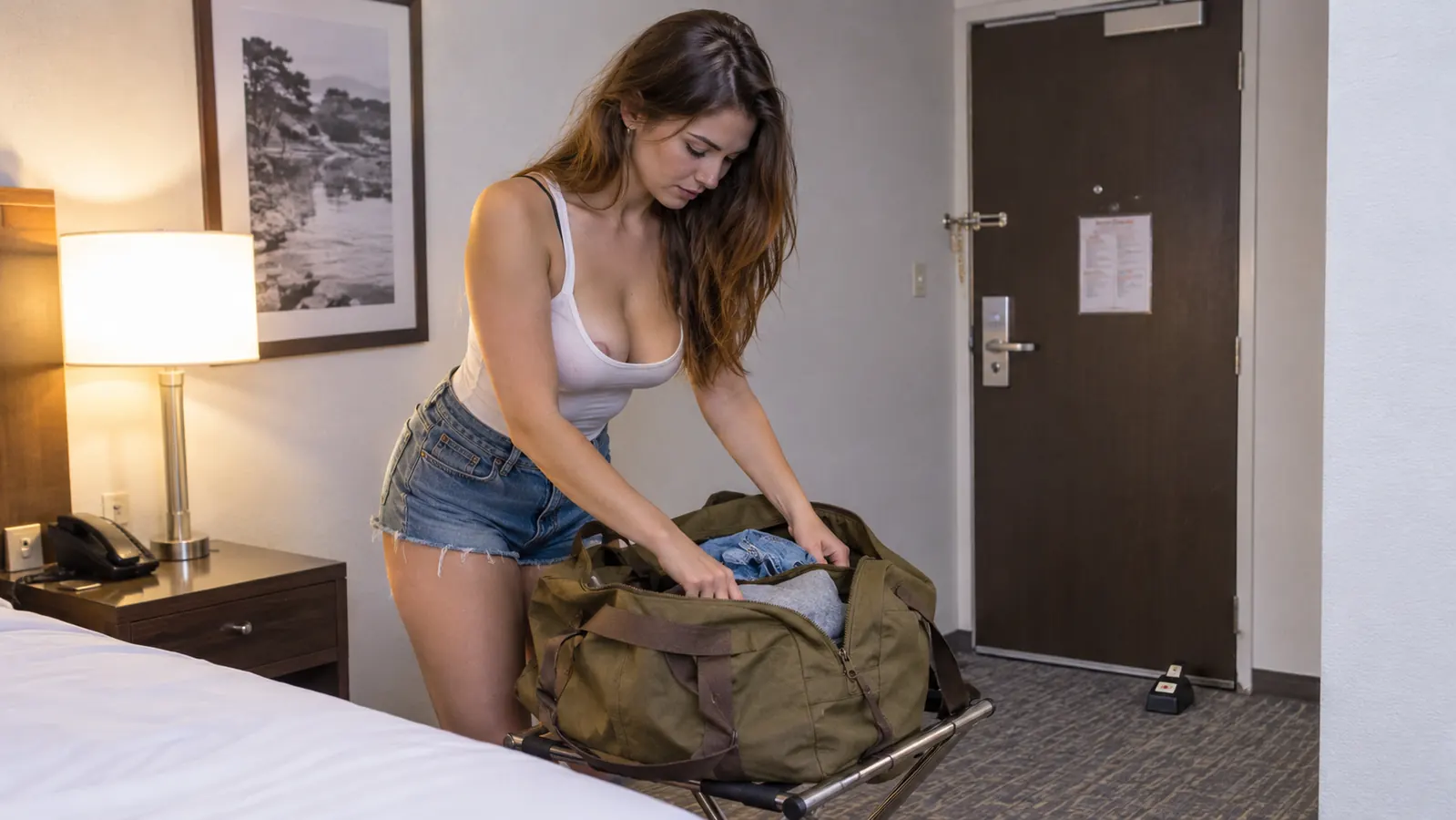
At 6.5 inches long, 1.75 inches wide and 1.75 inches tall, and 4.8 ounces on the scale, it vanishes into a carry-on. Hotel doors, dorm doors, a rented cabin with a latch that has seen better decades: those are all doors you do not control and cannot modify. The deadbolt and the swing bar in a hotel room are fine until the one night the front desk hands out a key to the wrong room. Four ounces of luggage is a fair trade.
The low battery indicator means it is not dead in the drawer
A dead battery turns security hardware into a doorstop in the literal sense. SABRE puts a low battery indicator on the unit so you get a warning before that happens. It is a small feature that separates a product meant to be relied on from a product meant to be sold. My rule is simple: test it on the first of the month, the same day you test the smoke detectors, and the indicator becomes a backup rather than the whole plan.
One per door is cheap enough to actually finish the job
The mistake people make is buying one. Buy three: the front door, the back door, and the door to the room where the important things live. In my house that is the closet with the papers, the cash, and my father's watch. The math works the moment you stop thinking of it as one purchase and start thinking of it as a layer. A layer you can afford to repeat is worth more than a fancy layer you bought once and never expanded.
It backs up your lock instead of trying to replace it
This is not a substitute for a deadbolt and I would never sell it as one. It is what you add after the deadbolt, on the theory that locks buy time and noise buys attention. A lock slows an honest thief down and stops the opportunist cold. A 120 dB siren in a quiet hallway changes the calculation for anyone standing there deciding. Two layers, one of them inexpensive, beats one expensive layer you never quite got around to installing.
What I'd Skip
Skip it if the door swings outward. A wedge only works against a door that moves toward it, so an out-swinging exterior door is not its job. Skip it for sliding patio doors and anything on a track. And skip it if there is a toddler or a large dog in the house that bumps doors at night, unless you enjoy being wide awake at midnight for no reason at all. Those are real limits and I would rather you hear them from me than find out at 2 a.m.
Be clear on what it is not, too. It does not call anybody. It does not send a notification to your phone. There is no monitoring desk behind it and no one who checks in if you do not answer. It makes noise, and that is the entire contract. If you want a system that dials out, buy a system that dials out. If you want the half second of warning and the kind of noise that makes a stranger leave, this is the least expensive version of that I know of.
Locks buy time. Noise buys attention. You want both, and the noise is the half most people never get around to.
Put One Under the Door You Actually Worry About
SABRE door stop alarm. 120 dB, non-skid pad, 4.8 ounces, one 9 volt battery, no wiring and no installation. Test it on the first of the month and forget about it the rest of the time.
Amazon Check Today's Price on Amazon →