
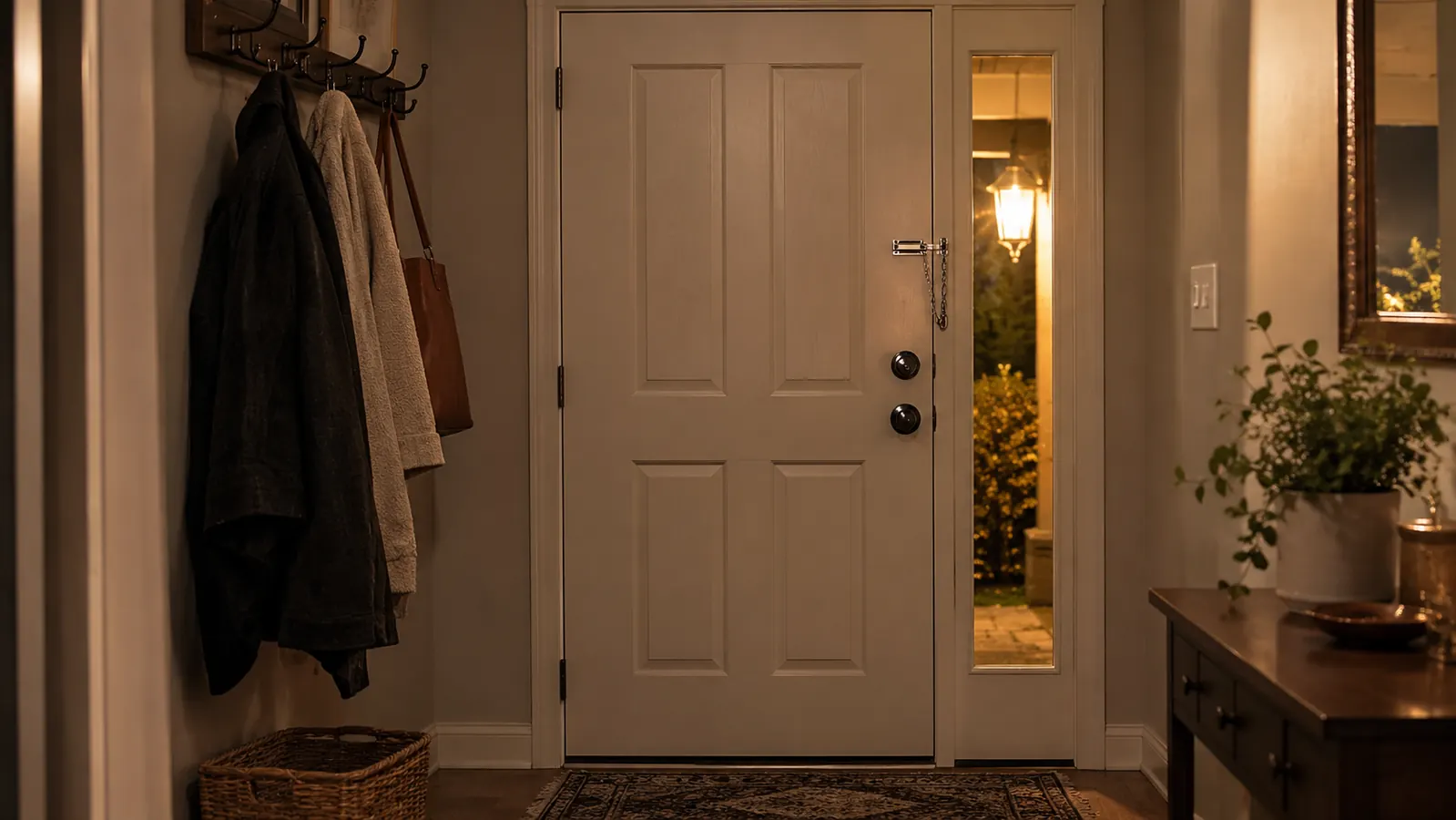
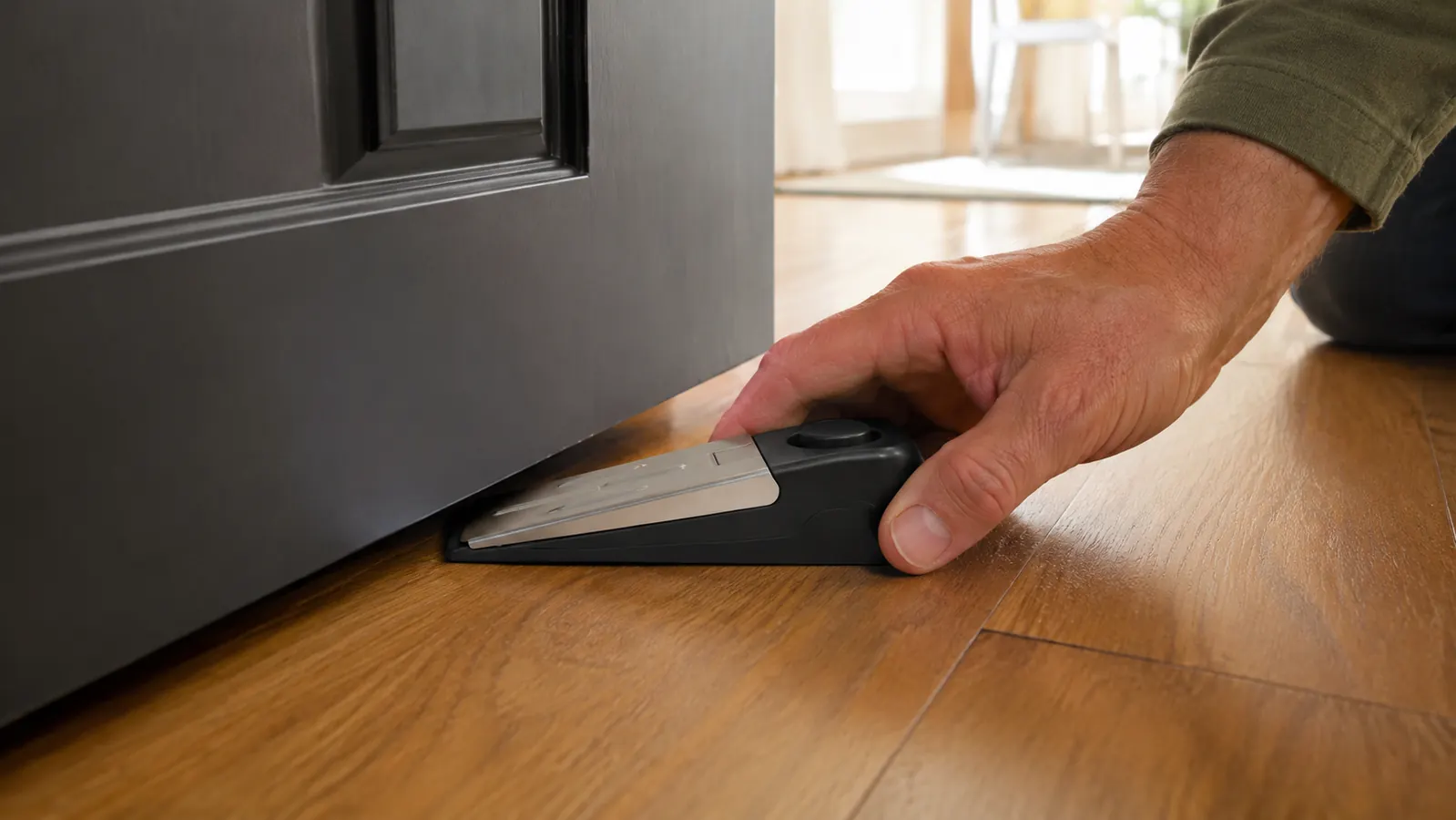
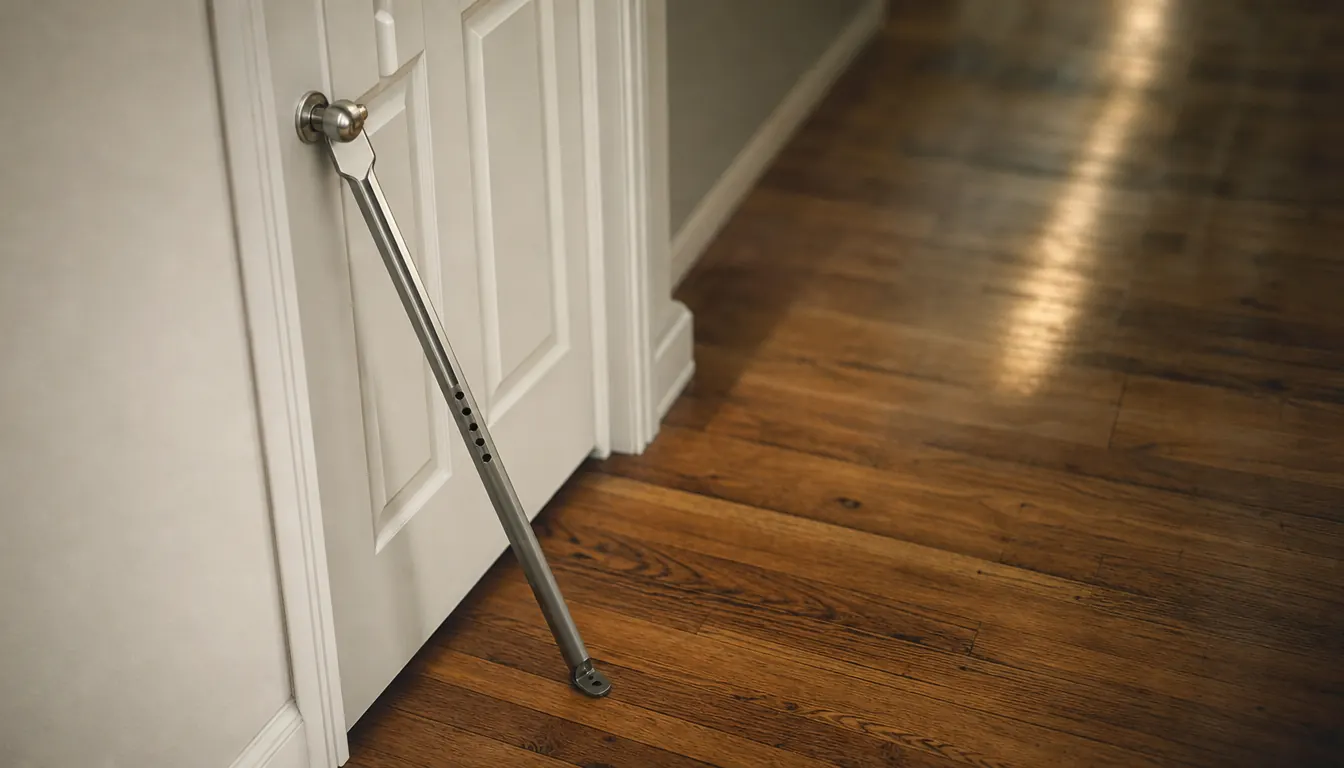
Short answer: they solve two different problems, and the one you want depends on whether you need to hear a door open or keep it from opening at all. The SABRE 120 dB Wedge Door Stop Security Alarm is a wedge that slides under the door and sounds a siren when pressure is applied. A door security bar is a steel tube that jams under the doorknob and physically holds the door shut. One is a warning. One is a wall. Most people I talk to end up wanting both, and the honest answer is that most people only need one. Let me sort out which.
I spent about thirty years as a residential locksmith in Columbus, and the calls that stayed with me were never the complicated ones. They were the simple ones. A front door with a good deadbolt and a frame somebody had kicked apart in four seconds. A latch that gave up because the strike plate was held by two half-inch screws. The one I think about most was a woman who left for groceries and came back forty minutes later to a front door standing open with the deadbolt still thrown. Nobody had picked anything. The door had been pushed, the jamb had split, and the lock was still doing its job perfectly while the door around it failed. That is the pattern. The hardware was fine. The door it was attached to was not. I am not going to tell you the neighborhood is dangerous. I am going to tell you that most doors fail in the same handful of places, and a small piece of hardware in the right spot covers more of them than an expensive lock in the wrong one. That is how I think about the SABRE wedge and about the door bar. Both are additions to a door that is already locked. Neither one replaces the lock.
| SABRE Door Stop Alarm | Door Security Bar | |
|---|---|---|
| What it does | Slides under the door and sounds a 120 dB siren when pressure is applied | Jams under the doorknob and braces the door against the floor |
| Blocks a real push | A wedge with a non-skid pad. It slows a door, it does not outmuscle one | A steel brace that takes the push and drives it into the floor |
| Alarm | 120 dB siren, rated audible up to 600 feet | None. Silent |
| Setup | Set it behind the door. No wiring, no mounting, nothing to adjust | Set the length once, then seat it under the knob each night |
| Power | One 9V alkaline battery, with a low battery indicator | None needed, ever |
| Door gap | Wants about 7/8 inch of clearance under the door | Does not care about the gap. Needs a hinged door and a level floor |
| Travels | 4.8 ounces and 6.5 inches long. Fits in a carry-on | Too long and too heavy to pack for a trip |
| Works while you are out | Partly. The siren sounds at the door, but nobody is notified | No. Somebody has to be home to seat it |
| Warranty | 90 days limited | Usually a year or more from the maker |
| Best for | Renters, travelers, and anyone who wants to be woken up | A solid second barrier on a home's main entry |
Where the SABRE Door Stop Alarm Wins
The wedge makes its case with the siren, and that is not a small thing. A door bar stops a door in total silence. Nobody upstairs knows anything happened until the morning. The SABRE is the opposite trade. It will not hold the door against somebody who is committed, but the moment the door puts pressure on the wedge it sounds a 120 dB alarm that the listing rates as audible up to 600 feet. I tested that the only way I could. Fresh 9V in, wedge set on the basement floor, door closed until it took pressure, then out to the back corner of the yard with the garage between us. I could hear it. Not faintly, either. Whether it carries 600 feet through drywall and a closed door is something I cannot answer from my own yard, and I would not buy it expecting a neighbor three doors down to come running. I would buy it expecting everyone inside the house to be awake in about a second, and that it will do. In a two-story house on a quiet street, that is the difference between an event nobody noticed and an event the whole block noticed. Most residential break-ins are counting on quiet. That is the market they are shopping in.
The second thing it has going for it is that it travels. It weighs 4.8 ounces and measures 6.5 inches long by 1.75 wide and tall, so it goes in a carry-on next to a pair of shoes. I have gotten more use out of a device like this in hotel rooms and in my daughter's apartment in Cincinnati than I ever expected, because those are the doors you cannot change. You do not own the lock. You do not know who has a key, whether the last guest propped the deadbolt on the way out, or who behind a front desk had access to a copy. The door usually has a healthy gap under it, which is the one place a hotel is more forgiving than a house. Setup is nothing. There is no wiring and no mounting. You drop it behind the door, and when the battery runs down a low battery indicator tells you before it goes quiet on you. That indicator matters more than it sounds, because a hotel room is exactly where you will not be thinking about a battery until the night it matters.
Where the Door Security Bar Wins
Where the bar wins is force, and I want to be blunt about that. A wedge with a non-skid pad is a friction device. It slows a door. It adds a little resistance and then it slides. A door security bar is a brace. It seats under the doorknob at an angle and its foot takes the push and drives it into the floor, so the harder the door is pushed the more the bar digs in. If the question is which one keeps the door closed while somebody leans on it, the bar wins and it is not close. The wedge's job is to make noise while the door moves an inch. The bar's job is to stop the inch. The forced-entry calls I went on almost never involved a defeated lock. They involved a strike plate held by two short screws that pulled out of soft pine, or a jamb that split, or a hollow door that came apart at the knob. A better lock cannot fix any of that. A bar can, on the middle of the door at least, because it moves the load off the jamb and onto the floor, and the floor does not care how hard somebody kicks. It is also the only one of the two that does its work before anybody makes a sound, and quiet prevention is worth more than a loud cleanup.
The bar also has no battery, and after thirty years of watching battery-powered things fail I do not say that lightly. Anything with a 9V in it has a shelf life you cannot see. The SABRE handles that better than most, with a low battery indicator and a compartment that only needs a small screwdriver to open, but it is still a device that eventually goes quiet on a shelf. The bar does not. It hangs on a hook by the door and works the same in year ten as in year one, and the only upkeep is glancing at the rubber foot now and then to see that it has not gone hard and slick. Then there is the warranty. The SABRE carries a 90 day limited warranty, which is honest but short, and most bar makers go a year or more. That is not a reason to skip the wedge. It is a reason to look at who is selling it to you and whether they will still be there in March when the battery needs replacing.
The 7/8 Inch Detail Nobody Mentions
Before you buy the wedge, go measure the gap under your door. The SABRE wants about 7/8 of an inch between the bottom of the door and the floor. That is common on interior doors and on plenty of front doors, but it is not universal. Here is how I check one in about ten seconds. Open the door, look at the gap, and slide a stack of coins under it. A quarter is just under an inch, so if a quarter slides through with room to spare, the wedge will seat. If a nickel will not fit, it will not, and no amount of adjusting changes that. On my own front door the gap runs close to an inch and the wedge sits flat. The door at the back of my basement is a different story. Somebody screwed a metal threshold strip to the floor down there years ago and it took up most of the clearance, so the gap is under half an inch and a wedge behind that door is decoration. I have also seen front doors with a brush sweep on the bottom, the kind meant to keep cold air out, and that sweep eats the gap entirely. Good for the heating bill, useless for a wedge. A carpeted room, a threshold with weatherstrip, or an old house where the door was planed to clear a rug can all drop the gap below what the wedge needs. If it does not sit flat and the door does not make contact with it, the alarm never triggers and what you own is a rubber doorstop. Measure first. It takes ten seconds, and it is the single most common reason this thing disappoints somebody.
The bar has its own conditions and they are different. It needs a hinged door with a knob to seat against, a floor flat enough for the foot to bite, and you to be home to put it in place. It is a device for occupied hours, not for a two-week trip. And I will say the same thing about both of them: if your door has a glass panel within arm's reach of the lock, neither product matters. Somebody breaks the glass, reaches through, turns the thumb turn, and the wedge and the bar are both sitting on the floor behind an open door. Glass is the door in that situation. Nothing you set on the floor fixes it. Same story for a sliding patio door. A wedge under a slider does nothing, because that door does not swing, it rolls, and a stick braced in the track is a different piece of hardware entirely. Know which door you actually have before you spend anything.
A wedge will not outmuscle anybody. What it does is make sure the twelve seconds somebody spends at your door are the loudest twelve seconds of their night.
What I Would Check Before Buying Either
Three things I would check before committing. First, which way the door swings and what is under it, because both products assume an inward-swinging door. Second, the floor. I have set one of these on hardwood, on tile and on low-pile carpet, and the difference is real. On hardwood the non-skid pad grabs and the wedge stays where you put it. Tile is about the same. On carpet it holds until somebody bumps the door and then it walks an inch or two and you reseat it. Deep pile is worse. If your entry opens onto a rug, set the wedge on the bare floor in front of the rug and not on the rug itself, then check it after a week to see whether it has drifted. Third, your own habits. A security device is only worth what it is worth when it is deployed. I have been in houses with a good wedge still in the drawer and a bar leaning in the coat closet, and in both cases the door was protected by a deadbolt and hope.
The other thing I would tell you is that these two are less competitors than a sequence. The bar is the barrier. The wedge is the notification. If you can only have one and your goal is to know, buy the wedge. If your goal is to hold, buy the bar. If your front door is the one that worries you and you are home most nights, put the bar under the knob and the wedge behind it, and then a person at that door has to beat a steel brace while a siren runs at 120 dB. That is a longer job than most people are willing to take on, and a longer job than most of them planned for when they picked the house. The point of either product is not to make your door unbeatable. It is to make your door the least attractive one on the street, and both of them do that in different currencies.
If you want to know the moment the door moves, put a siren behind it
The SABRE wedge sounds at 120 dB on door pressure, weighs 4.8 ounces, and runs on one 9V battery with no wiring and nothing to mount. Check the gap under your door first, then check the listing.
Amazon Check Today's Price on Amazon →Who Should Buy Which
Buy the SABRE if you rent, if you travel, or if what you actually want is to be woken up. Renters get the most out of it because it asks nothing of the door: no drilling, no new lock, no conversation with a landlord about whether you are allowed to change the hardware. Travelers get the second most, because a hotel door with a healthy gap under it and a lock you do not control is exactly the situation it was built for. And anyone who lives alone and wants warning rather than a fight should have one behind the bedroom door as well as at the front, since a bedroom door with a wedge behind it buys the few seconds it takes to get a phone in your hand.
Buy the door security bar if you own the place, if you have one entry that worries you, and if you are usually home at night. It is the better barrier and the worse traveler. It is also the one I would put on a front door that already has a decent deadbolt, because a deadbolt holds the lock side of the door and a bar braces the middle of it, and those are two different failures. Fit matters here too. A bar set too short rattles loose under a push, and a bar set too long will not seat under the knob at all, so adjust it once with the door shut and leave it. If your budget stretches to both, buy both. If it only stretches to one, be honest with yourself about whether you want to hear it or stop it.
The loudest thing in the room is usually the reason somebody leaves
One wedge, one 9V battery, no wiring. SABRE rates the siren at 120 dB and the wedge fits any inward-swinging door with about a 7/8 inch gap under it.
Amazon See Today's Price on Amazon →