
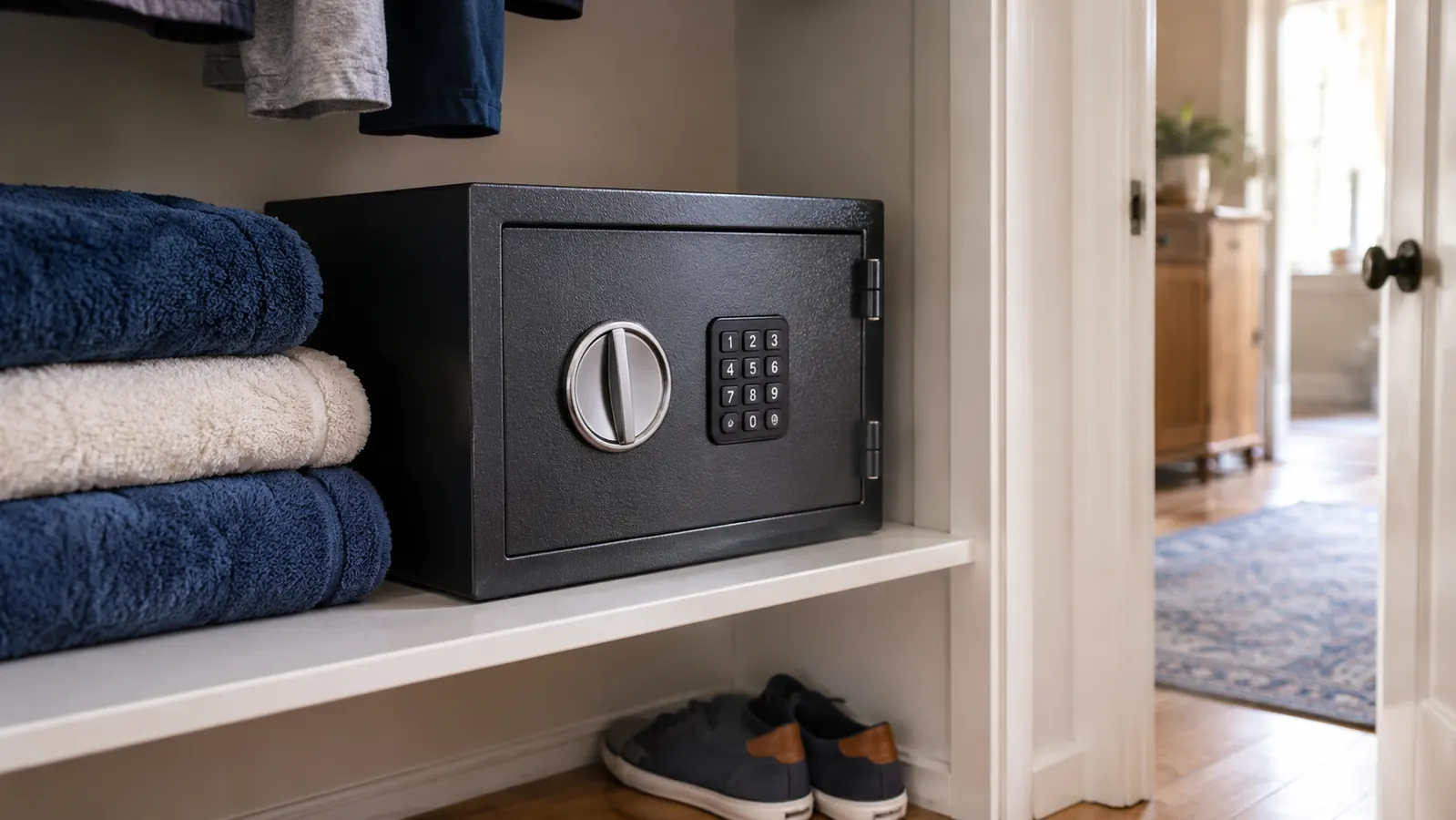
Most people buy a home safe the way they buy a fire extinguisher. Fast, late, and without reading the label. I spent close to thirty years as a residential locksmith in Columbus, and I have opened more of these boxes than I can count, usually for the owner who forgot the code, occasionally for a family clearing out a parent's house. The ones that held up were never the heaviest or the most expensive. They were the ones the buyer had thought through before spending a dime. This is the thinking-through part. I'll use the TIGERKING biometric safe as the running example, a 1.2 cubic foot steel box that weighs 20 pounds, because it is the one bolted to the shelf in my own bedroom closet and I can tell you precisely where it earns its place and where it does not.
Here is what I have seen go wrong. Somebody buys on weight alone, or on the number of bolts, or because the thing looked serious in the product photo. Then it arrives, they set it on a closet shelf, and it never gets fastened to anything. A person breaking into a house is not going to spend twenty minutes defeating a lock. He will pick the box up and carry it out. Twenty pounds is nothing. I once watched a man walk out of a garage with a loaded safe tucked under one arm like a toolbox. So the buying decision is only half the job. The other half happens the afternoon the box shows up.
The Box Is Half the Job. This One Ships With the Other Half in the Carton.
The TIGERKING biometric safe arrives with pre-drilled mounting holes in the back and the bottom, plus four expansion bolts. That is the piece most safes leave you to solve on your own.
Amazon Check Today's Price on Amazon →The Five Decisions That Actually Matter
Work through these in order. Each one narrows the next. By the bottom of the list you will either want this safe or know exactly why it is wrong for your house.
Step 1: Decide What You Are Actually Guarding Against
Write it down before you shop. Not "burglars" in general, but the specific thing. For my house it is four items: the deed and the insurance folder, a few hundred dollars in cash we keep for emergencies, my father's watch, and Carol's mother's rings. That is a short list, and a short list changes what size box you need. If your list is a shoebox full of jewelry, a 1.2 cubic foot safe is generous. If it includes a binder of stock certificates or a rifle, you are shopping in a completely different category and nothing in this article applies to you.
The second thing to decide is what you are realistically defending against. There are four, and they do not get equal treatment from any safe. A walk-away burglary is the common one, and the good news is that most residential break-ins are fast, noisy and opportunistic. A box that is bolted down and takes time to open is usually enough to send someone out the door. The TIGERKING helps here beyond the steel, because it has a vibration alarm, which means a person rattling it in a quiet hallway is making noise the whole time he is doing it. That single feature matters more in a finished basement than it does in an attic.
Fire and water are the other two, and I want to be straight with you. Nothing in the TIGERKING listing claims a fire rating, and a steel box with a thin body is not a fire safe no matter what the marketing around the category implies. If a house fire is your primary worry, you need a rated document chest first and a bolted-down safe second. If a pipe bursts above your closet, no safe on the market saves wet paper. Deal with those two problems separately. This box is for the first problem and for keeping the family out of the jewelry.
Step 2: Measure the Space and the Contents Before Anything Else
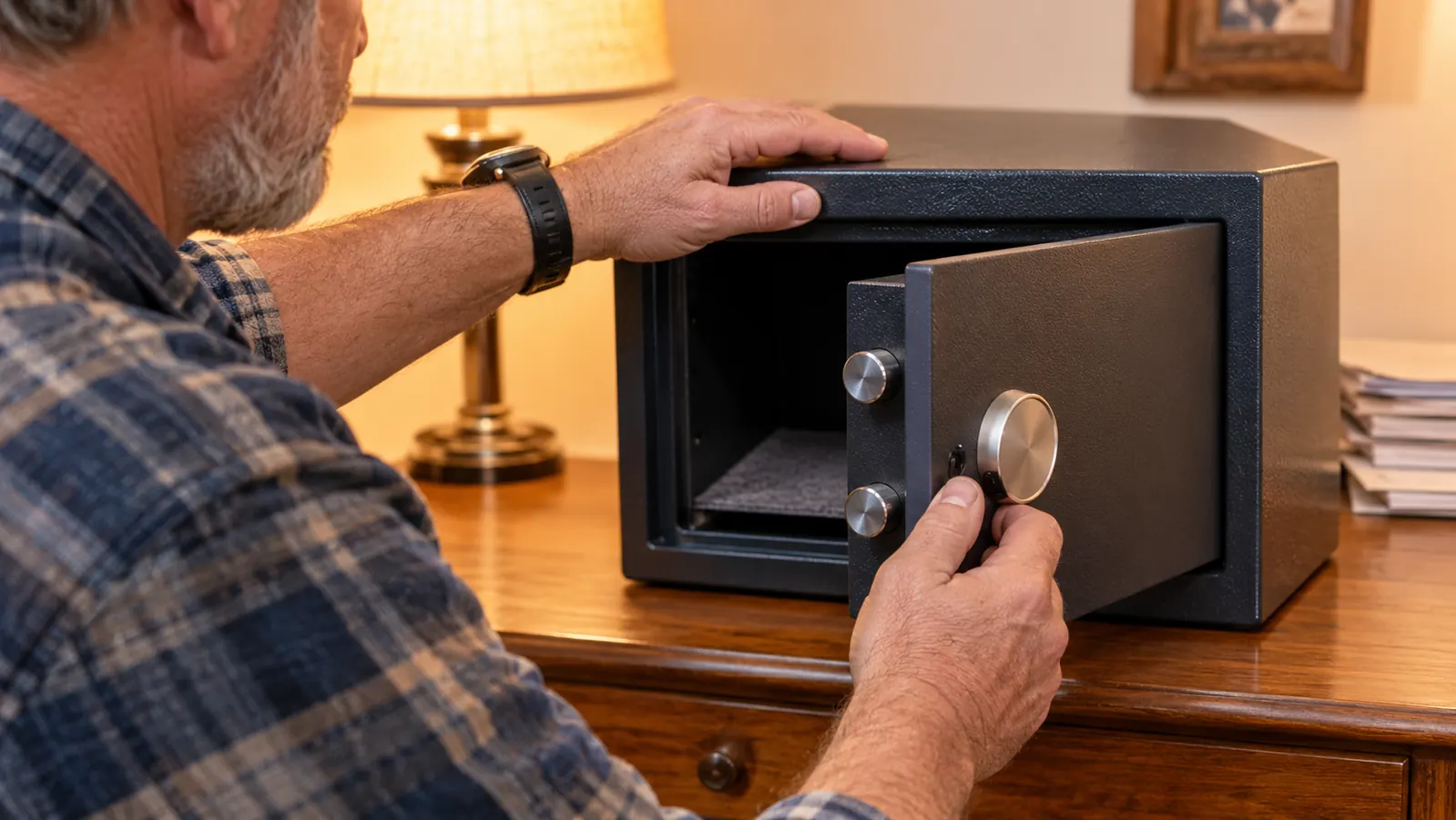
The TIGERKING measures 13.8 inches wide, 9.9 inches deep and 9.9 inches tall on the outside. Those are the numbers that decide whether the plan works, and they surprise people in both directions. The 9.9 inch depth is the one that trips up most closets, because a shelf that holds a laundry basket will not necessarily swallow a box almost ten inches front to back once you allow for the door to swing. Measure the shelf, measure the gap between the shelf and the rod above it, and measure the closet doorway. You cannot get the box into the closet if it will not fit through the opening.
Then think about the inside. I keep a manila envelope of documents lying flat, a small cash box, and two ring boxes. That fills maybe half of it, which leaves room for things I have not thought of yet. There is a removable shelf, so you can split the space into a taller lower bay and a flatter upper one, and I would use it that way rather than stacking paper. Remember that exterior height is not interior height. The door, the frame and the body walls take a bite out of all three dimensions, so plan for less room than the outside suggests.
One more measurement that people skip: where you will stand while you open it. A safe in the back corner of a deep closet is a safe you will stop using by March, because getting to it means moving three coats and a vacuum. Put it where you can reach it standing up with one hand free.
Step 3: Choose a Lock Your Household Will Actually Use
This is where most buying decisions get made for the wrong reason. A key lock is dependable and I have no complaint about the mechanism. My complaint is human. A key on a ring in a drawer is a key that gets lost, and a key in the same room as the safe is not security, it is decoration. I have been called out to open safes for people who owned the key and simply could not find it. Twice it turned up in a coat pocket. Once it turned up in a different house.
A fingerprint reader solves the access problem because your hand is the key and it is attached to you. The TIGERKING uses a biometric lock as its main entry, with a combination backup and two emergency keys in the box. That combination is the right shape for a house like mine. When I come in with an armload of groceries and need the passport, I put a finger on it. When Carol needs in and her print is not enrolled, she uses the combination. And when the electronics eventually misbehave, as electronics do, the keys are the last line and they live in a drawer in another room.
Two practical notes. Enroll more than one finger, and enroll the same finger twice from slightly different angles. My right index finger is enrolled cold and clean, and my left thumb is enrolled for when my hands are wet or grubby from the garage. Also, if you have a family member with very worn prints, enroll that person's finger on a good day, not after gardening. A biometric lock is only as reliable as the print you gave it.
Step 4: Look at the Steel, the Door and the Bolts
Three things matter on the box itself: the body material, the door construction and the locking bolts. The TIGERKING is an alloy steel body at 20 pounds, with a 50 mm door construction and two 25 mm locking bolts. Translated out of spec language: 25 mm is roughly an inch, and those two bolts are the parts that slide out of the door and into the frame when you turn it closed. On a thin-bodied safe, the bolts are the whole fight. A pry bar has to bend the frame far enough to clear an inch of steel at two points, and that is a slow, loud job.
The 50 mm door construction is the other half of that. A door that flexes under a pry bar gives the bolts room to walk out. A door that does not flex holds them in place. This is the difference between a safe and a cabinet, and you cannot tell by looking at a photograph, which is why a 20 pound box with a real door and real bolts beats a heavier box with a hollow one.
What this is not: a commercial safe. It is not a TL-15 rated unit, it is not a fire safe, and it is not going to stop two men with a grinder and twenty minutes. The 1-year limited warranty tells you what the manufacturer thinks the box is built for. Buy it to stop the fast burglary, the curious teenager, the contractor working upstairs and the housekeeper's nephew. That is the actual threat model in most homes, and a heavier safe does not improve on it unless you also improve the bolts holding it to the floor.
Step 5: Bolt It Down, or You Have Bought a Carry Case
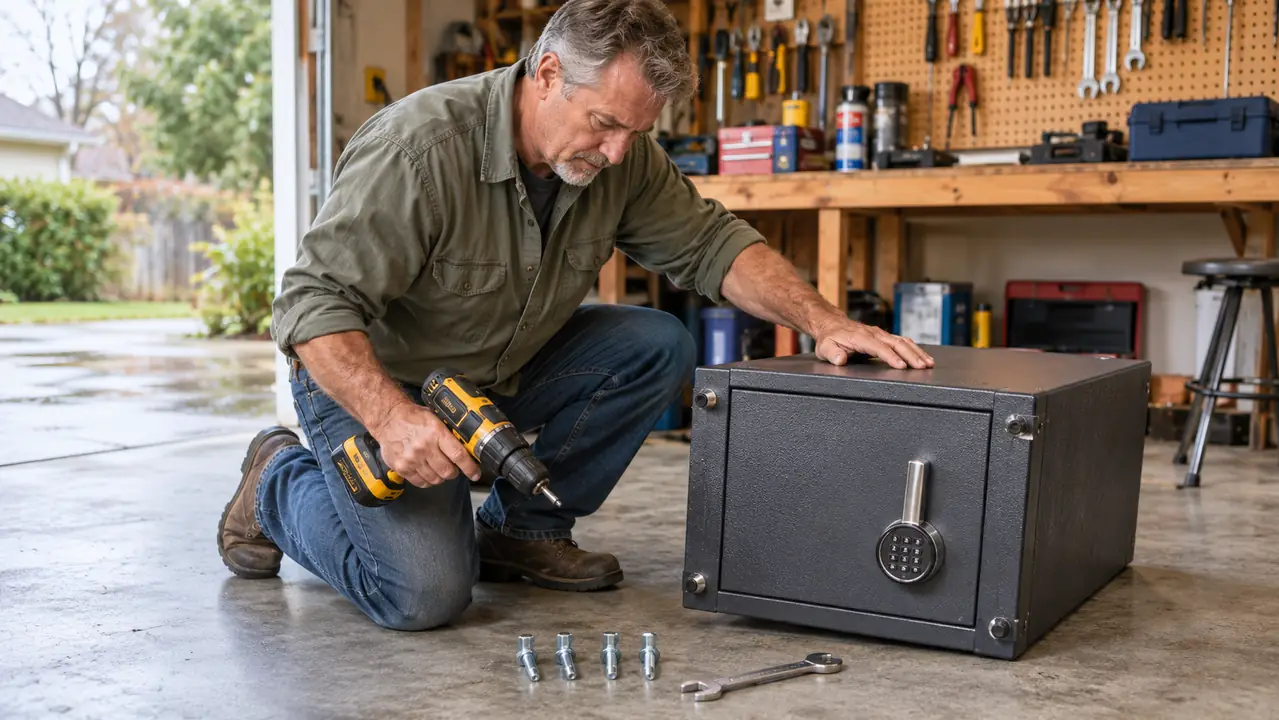
This is the step people skip and the one that decides whether all of the above was worth doing. The TIGERKING comes with pre-drilled holes in the back and the bottom and four expansion bolts. Pick one orientation. Do not use both. You are trying to stop the box from being carried, not to armor it.
Floor mounting is my preference in a closet, because it is the harder direction to attack with a pry bar and it hides the bolt heads inside the box. Set the safe where you want it, mark the holes through the bottom plate with a pencil or a nail, pull the box out, drill, then set the bolts. If you are going into wood, find the joist or the subfloor, not just the finish board. If you are going into concrete, you want a masonry bit and a hammer drill, and the expansion bolts in the carton are meant for exactly that job. Wall mounting works too, and it is the better answer in a garage where the floor floods, but you need to hit studs or masonry, not drywall alone.
I tested this one on the basement floor and then moved it to the bedroom closet, and the difference in how it feels is the whole point. On a shelf it is a box. Bolted through the bottom with four expansion bolts, it does not move when you pull the door. That is a one hour job on a Saturday and it changes the category of the thing you own.
What Else Helps
Four small habits make a safe work better than any feature you can buy. First, put a desiccant packet inside and swap it once a year. Steel boxes in Ohio basements collect moisture and paper does not forgive it. Second, skip the plastic bag and use an acid-free document sleeve for anything you would hate to lose. Third, photograph the contents and every serial number, and email those photos to yourself. If the box does walk out the door, you will have a list for the insurance company instead of a blank stare. Fourth, change the batteries on a schedule whether the lock complains or not, and keep the emergency keys somewhere that is not the room the safe lives in. Mine are in a kitchen drawer. Carol's daughter in Cincinnati has a third set, which is not something I would ordinarily recommend, but she is four hours away and it is a small house.
One last thing about placement. Do not put the safe in the room a burglar checks first. That is the master bedroom closet, and it is where most people put theirs. A hall closet, a linen cabinet, or a spot in the basement near the workbench all get found later if they get found at all. And whatever you do, do not leave the carton on the curb. The box tells anyone driving past that there is a new safe in the house.
A 20 pound safe bolted through the bottom with four expansion bolts is a different problem than the same safe sitting on a shelf. Same box. Different outcome. That is the whole decision, and it costs you one Saturday morning.
Measure the Shelf, Then Order the Box That Fits It
13.8 inches wide, 9.9 inches deep, 9.9 inches tall, 1.2 cubic feet inside. Four expansion bolts and two emergency keys in the carton. It is the one in my closet, and it has not given me a reason to move it.
Amazon Check Today's Price on Amazon →