
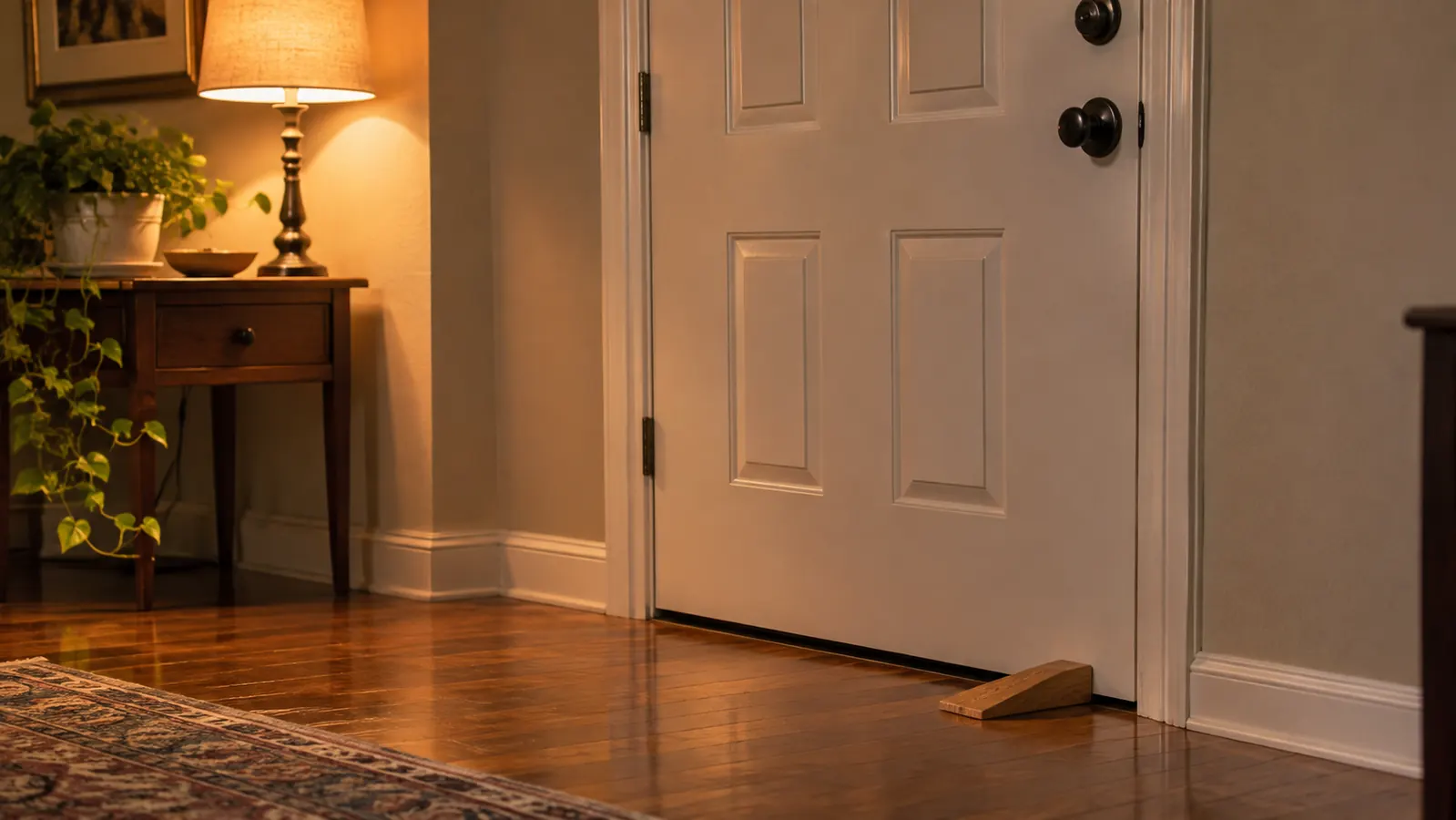
Almost every entry door I opened in thirty years of house calls had the same problem, and it was rarely the lock itself. It was the frame, the strike plate, or the gap under the door. You can spend a Saturday fixing all three and still want one more layer for the night you come home tired and that door is the only thing between you and the hallway. That is the job a wedge door stop alarm does, and it does it without a key, a code, or a phone. The SABRE 120 dB Wedge Door Stop Security Alarm is about as simple as hardware gets: a wedge you push under the door with a pressure plate inside it. When the door moves against that plate, the siren goes at 120 decibels. No wiring, one 9 volt battery, 6.5 inches long and 4.8 ounces.
Below is the order I would actually do it in. Measure first, test second, place third, and then decide what else on that door deserves ten minutes of your evening before you go to bed.
The loudest thing you can put under a door, and it runs on one battery
SABRE's wedge alarm needs no wiring and no setup beyond a 9 volt battery. Door pressure hits the plate and the siren sounds at 120 decibels. Rated 4.4 across more than 7,000 reviews.
Amazon Check Today's Price on Amazon →Five Steps, in the Order I Would Do Them
Step 1: Measure the Gap Under the Door, Not the Door Itself
The listing says this wedge is built for front doors with about a 7/8 inch gap between the bottom of the door and the floor. That is a fit number, not a marketing number, and it is the first thing to check. Too much gap and the wedge slides forward under the door instead of catching it. Too little and the door drags the wedge across the floor every time somebody walks through, which wears the non-skid pad and teaches you to stop bothering with the thing by week two.
Get down on the floor with a tape measure. If you cannot find one, stack coins next to the gap until the stack matches the height and count them. Write the number down. Somewhere between three quarters of an inch and an inch, this stop seats properly and the door contacts the wedge before it clears it. If your gap is noticeably wider than that, the door has to travel further before anything happens, and a thin strip of non-slip shelf liner under the wedge will take up some of the slack. If the gap is narrower, expect the door to drag and expect to be annoyed.
While you are down there, look at the floor itself. The wedge is 6.5 inches long, 1.75 inches wide and 1.75 inches tall, and it weighs 4.8 ounces, so it will sit under almost any door. On hardwood or tile the non-skid pad does most of the work. On deep pile carpet the wedge sinks in, and a sunken wedge gives the door less to push against. The door at the bottom of my basement stairs sits over a low pile rug, and that is about as much carpet as this thing wants under it.
Step 2: Pick the Door That Is Actually on Your Path to Bed
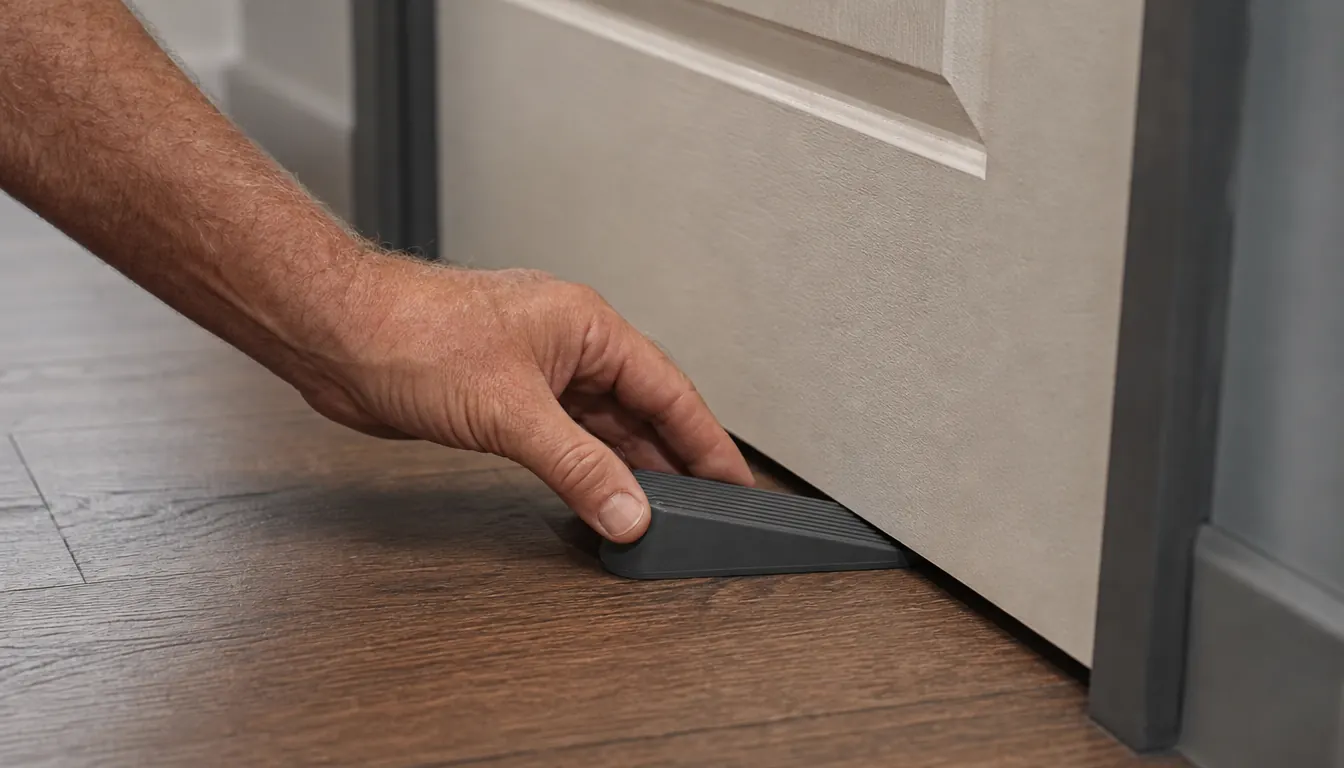
A wedge stop only works on a door that swings toward you on the side you are standing. That sounds obvious until you watch somebody set one on the wrong face of a door and wonder why it does nothing at all. You place it on the interior side, snug against the bottom of the closed door, so that anything opening that door has to move the wedge first.
Which door, though? Not the one closest to the street. The one on the path between an entry point and where you sleep. In a two story house that is usually the front door and whatever door connects the garage or the basement to the living space, because those are the two people forget. I have a front door and a basement door off the attached garage. The basement door is the one that gets the wedge at night, because a deadbolt on a door I cannot see from the kitchen is worth less to me than a siren I can hear from the bedroom.
If you rent, this is the one piece of door security you can install without asking anybody's permission and without leaving a mark. No holes, no screws into the frame, nothing the landlord will ever know about. That alone is why I recommend it to renters before I recommend a single other product, and I say that as a man who spent three decades selling and fitting locks.
Step 3: Load a Fresh Battery and Test the Siren Before You Need It
The SABRE takes one 9 volt alkaline battery, and the compartment cover comes off with a small screwdriver. That is the entire installation. There is no wiring and nothing to pair, which is exactly why I suggest it to people who do not want another device competing for their wi-fi and their attention.
Before you trust it, test it. Put the battery in, set the wedge on a hard floor, press the plate with your hand and step back. The siren is rated at 120 decibels and the listing puts it as audible up to 600 feet, which is not a polite beep. Do this on a Saturday afternoon rather than at eleven at night, and tell whoever you live with that you are about to do it. Carol still brings up the afternoon I tested a door alarm in the front hall without warning her first.
The unit has a low battery indicator, and that matters more than people give it credit for. An alarm with a dying battery is a wedge with extra steps. Test the siren once a month, on the same day you test your smoke alarms if that helps you remember, and replace the 9 volt about once a year whether the indicator complains or not. Batteries are the one part of this system that fails quietly.
Step 4: Set the Wedge So the Door Pushes Into It, Not Over It
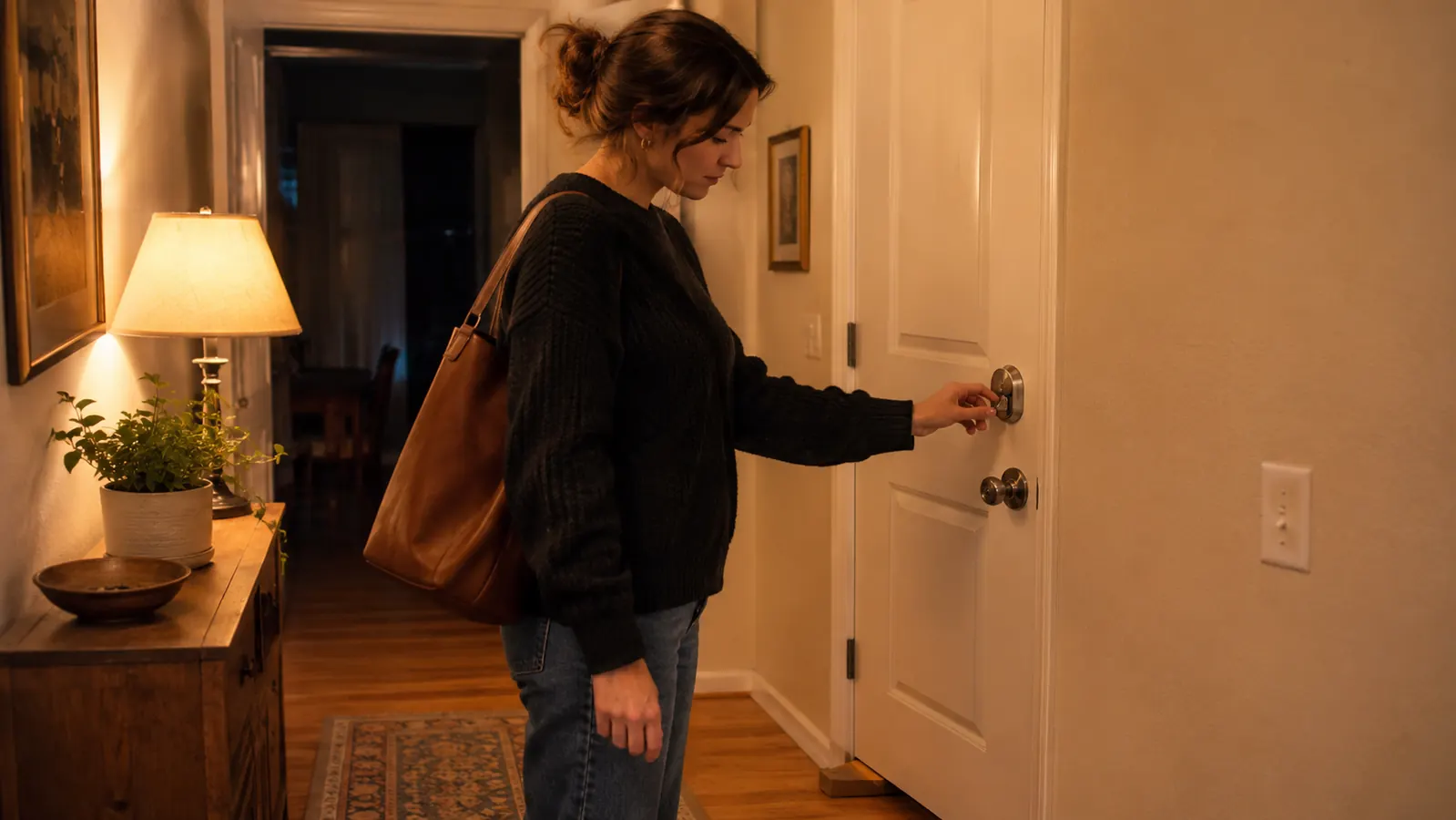
The order of operations at night matters more than it sounds. Lock the door, throw the deadbolt, then set the wedge. Set the wedge first and you will find yourself nudging it out of place every time you touch the door, and a wedge that has been nudged is no longer snug against anything.
Slide it in until the back of the wedge meets the bottom edge of the door with a little resistance, non-skid pad down on the floor. Then press the door gently by hand from the inside to confirm it contacts the wedge and triggers the plate rather than riding up over the slope. Gentle is the word. Shove the door and you will set the siren off in your own ear at close range, and you will only do that once.
I want to be straight about what this thing is, because the product photos flatter it. A wedge door stop alarm does not stop a door. A determined person with a shoulder can move almost any residential door ever hung. What the SABRE does is make the two seconds after somebody touches that door the loudest two seconds of their evening, at 120 decibels, in a house they expected to be quiet. That is a different product from a barricade, and you should buy it expecting the alarm, not the barricade.
Step 5: Turn It Into a Two-Minute Routine and Take It With You
The habit is what makes any of this work. Mine takes about ninety seconds: front door locked, deadbolt thrown, wedge set, porch light on, then the same loop at the basement door before I go up the stairs. Do it in the same order every night and you stop having to remember it. Skip it twice in a row and it stops being a habit, which is the real failure mode with inexpensive security hardware.
Take it with you when you travel. At 4.8 ounces and the size of a paperback spine it disappears into a dopp kit or a laptop bag, and it is the one piece of door hardware you can carry to a hotel, a rental, or a dorm room. My daughter lives in Cincinnati in an apartment where she does not control the door, and hers travels in her suitcase. Hotels are the case I hear about most from people who ask me about these, and it is the situation where you have the least control over the door and the most reason to want noise.
One more thing worth knowing before you buy: the manufacturer warranty is 90 days limited. That is short, and I would rather tell you than have you find out. It is a reason to test the unit hard in the first week rather than the first month, while you still have room to send it back.
A wedge alarm does not stop a door. It makes the two seconds after somebody touches that door the loudest two seconds of their evening, and on most nights that is the whole job.
What Else Helps
The wedge is the last layer, not the first. Before you spend a night trusting it, take a screwdriver to the strike plate on that door, the metal plate on the frame that the deadbolt slides into. Most builders use half inch screws that only bite into the soft pine trim, and trim does not hold anything. Replace them with three inch screws that reach the framing stud behind it and the deadbolt stops being decorative. That is a ten minute job with a screwdriver you already own, and it does more for that door than any alarm on the market.
Then look at the door itself. A hollow core door hung on an exterior frame is a problem no alarm fixes. A solid door, a deadbolt that seats fully, and a strike plate screwed into the stud are the three things that make a door slow to open, and slow is what you are buying. Add light on the outside, because a lit entry is the cheapest deterrent there is, and keep a spare key with a neighbor instead of under a mat or in a fake rock where every person who has ever looked for a key knows to look.
And nothing on this list protects what is inside the house if somebody does get in. Papers, cash, and the two heirlooms worth keeping belong in something bolted down, not in a bedroom drawer. That is a separate conversation and a separate purchase, but it is the same evening's work: harden the door, then decide where the irreplaceable things live. Do both and you will sleep better than you will with either one alone.
Set it tonight, test it Saturday, stop thinking about it
4.8 ounces, one 9 volt battery, no wiring, no installation. Set the SABRE wedge behind a locked deadbolt and door pressure becomes 120 decibels.
Amazon Check Today's Price on Amazon →