
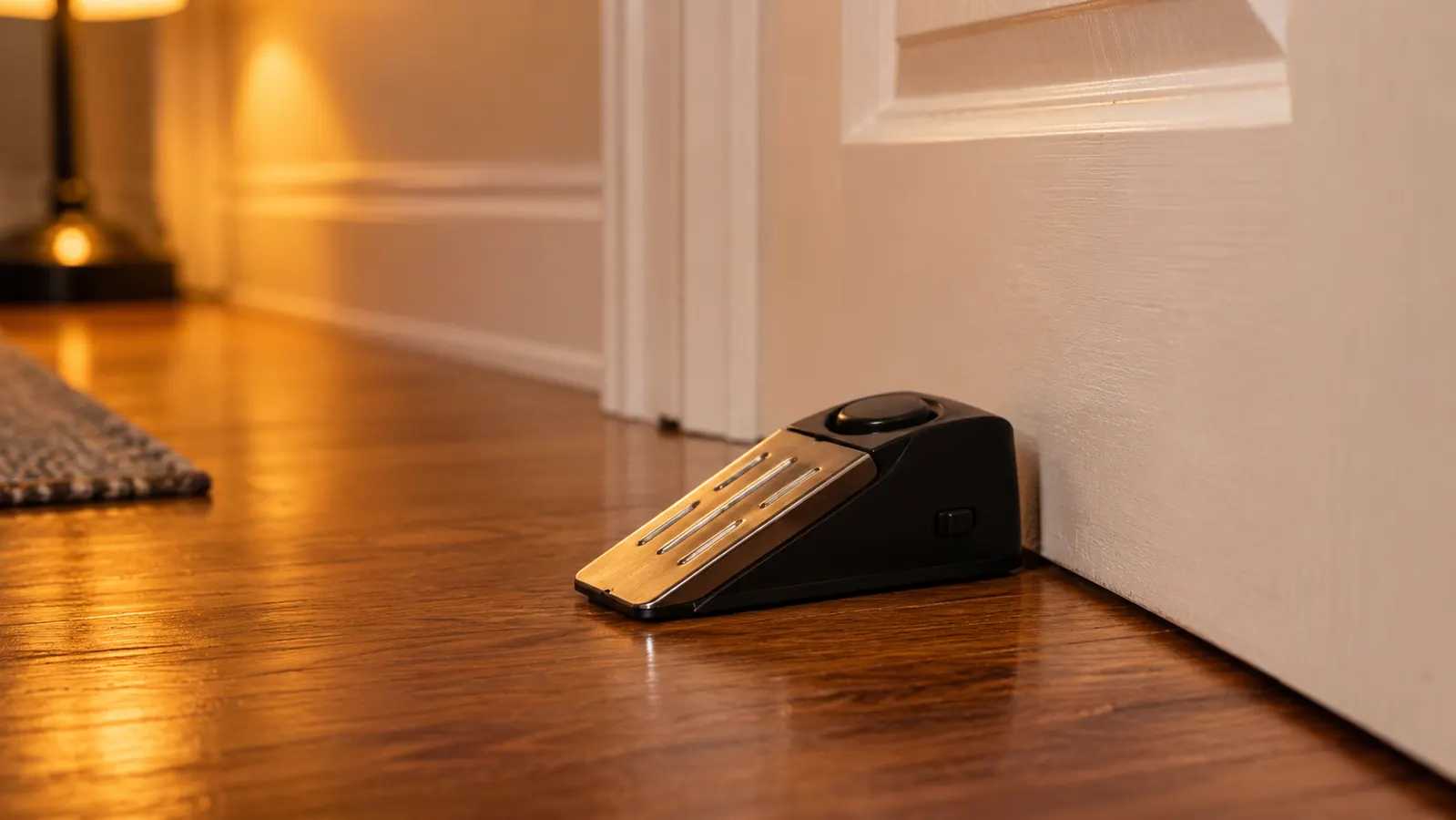
The first thing I look at in any house is the gap under the front door. Thirty years of hanging doors and rekeying locks will do that to a man. Most of the doors I saw around Columbus had a quarter inch of daylight down there, some had three quarters, and a few had enough room to slide a magazine under. That gap is the whole reason the SABRE 120 dB Wedge Door Stop Security Alarm exists, and it is also the reason a fair number of the people who buy one end up disappointed.
It is a good little device. It is not the device the listing photos suggest. I have kept this one on my floor for the better part of a month, moving it between the front door, the back door and the top of the basement stairs. Nobody paid me to write this and I bought it the way you would. What follows is the version of the review I would give a neighbor over the fence: what the wedge does well, where it quietly fails, and who should keep their money in their pocket.
The Quick Verdict
A genuinely loud wedge that only works on the right door, and only as a warning. Buy it for noise, not for strength.
Amazon Check Today's Price →If your front door has the right gap, this is a low cost second set of ears for it
The SABRE wedge runs on one 9 volt battery, needs no wiring, and sounds at 120 dB the moment the door presses against it. Measure your gap first, then check today's price.
Amazon Check Today's Price on Amazon →How I Tested the SABRE Wedge Alarm at Home
I started at the front door, because that is where the mail comes through and where a stranger would try first. I measured on a Saturday morning in October with a folding rule and a notepad, mostly because Carol wanted to know why I was kneeling in the hall with a flashlight. The gap there ran a hair under three quarters of an inch at the strike side and seven eighths at the hinge side, both inside the range SABRE gives for this unit. The wedge is 6.5 inches long and 1.75 inches wide and weighs 4.8 ounces, so it does not disappear under the door and hide from you. You can see where it is sitting, and that matters more than people expect, because a security device you cannot find in the dark is one you will stop setting.
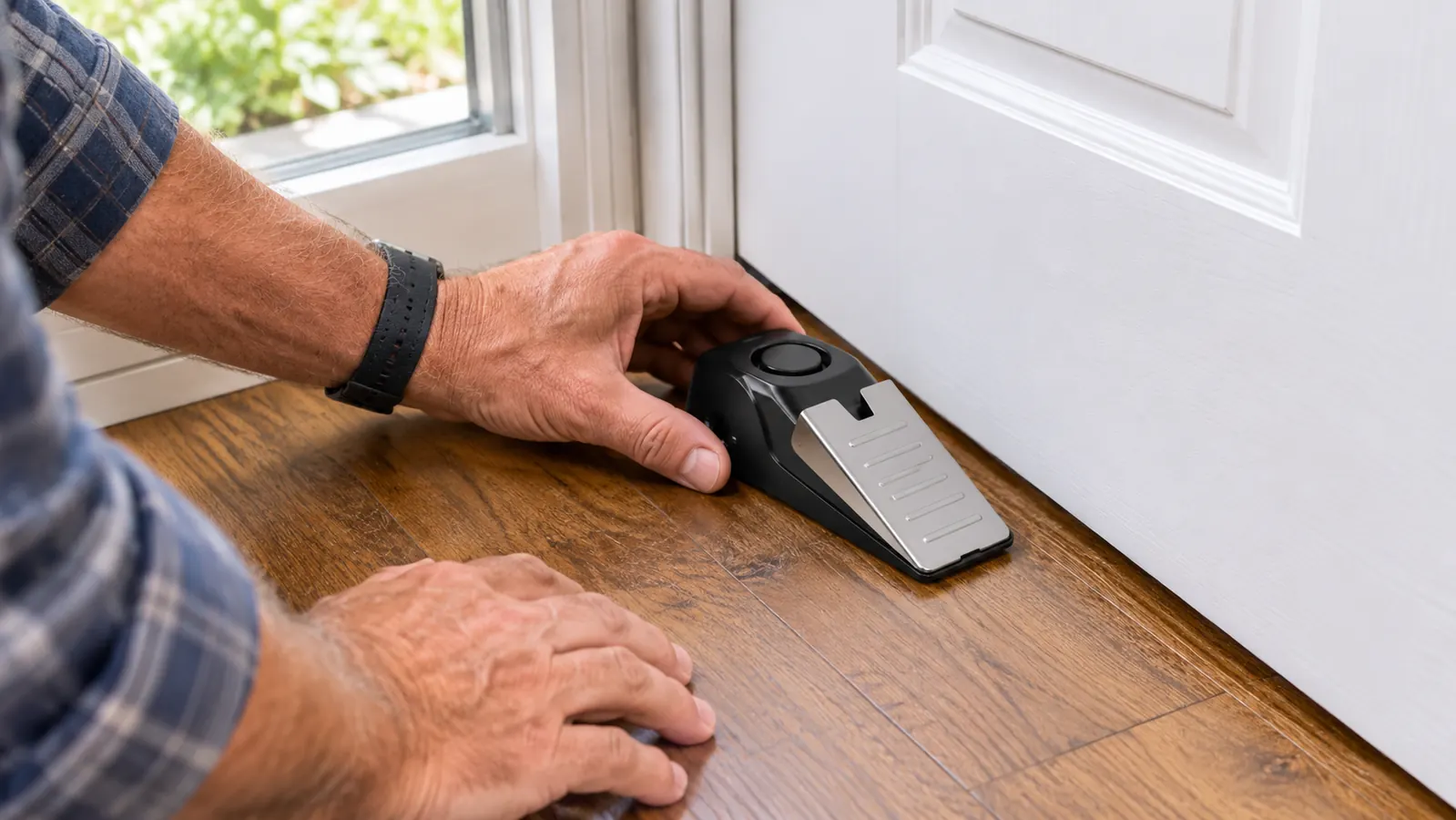
My first instinct was to shove it hard against the threshold and call the job done. That was wrong. Jammed tight to the jamb, the door came down and skated the whole unit forward a couple of inches without ever putting real weight on the paddle, and the alarm never made a sound. I backed it off until it sat an inch or so out from the threshold, the door caught the sloped face on the way down, and after that it fired every single time. A small adjustment, but it is the difference between a device you trust and one you quietly quit bothering with.
I dropped it on the hardwood, swung the door until the alarm was armed, then went outside and pushed the way somebody would if they were checking whether the house was empty. The alarm went off before the door had moved an inch. Carol was upstairs with the radio on and heard it through a closed bedroom door. I did the same at the top of the basement stairs, where the door is an old hollow core slab that swells and catches on the frame in wet weather, and got the same result, though it took a firmer push there because that door sits a little high.
The back door was a different story. It has an old threshold and the door drags on the sill in humid weather. Twice it set the alarm off on its own when the door drifted in the frame overnight. That is not a defect, it is just physics. A door that moves will trip a device built to notice pressure, and an old door that does not latch cleanly will move.
The 7/8 Inch Gap Decides Whether This Works
The listing says the alarm suits front doors with a 7/8 inch gap between the bottom of the door and the floor, and it means that literally. The wedge works because the door comes down on the sloped face as it swings, drives the unit forward, and trips the alarm. Too little gap and the door skates the whole wedge across the floor without putting any weight on it. Too much gap and the door rides up over the top and never makes contact at all. There is a workable band in the middle and it is narrower than the photos imply.
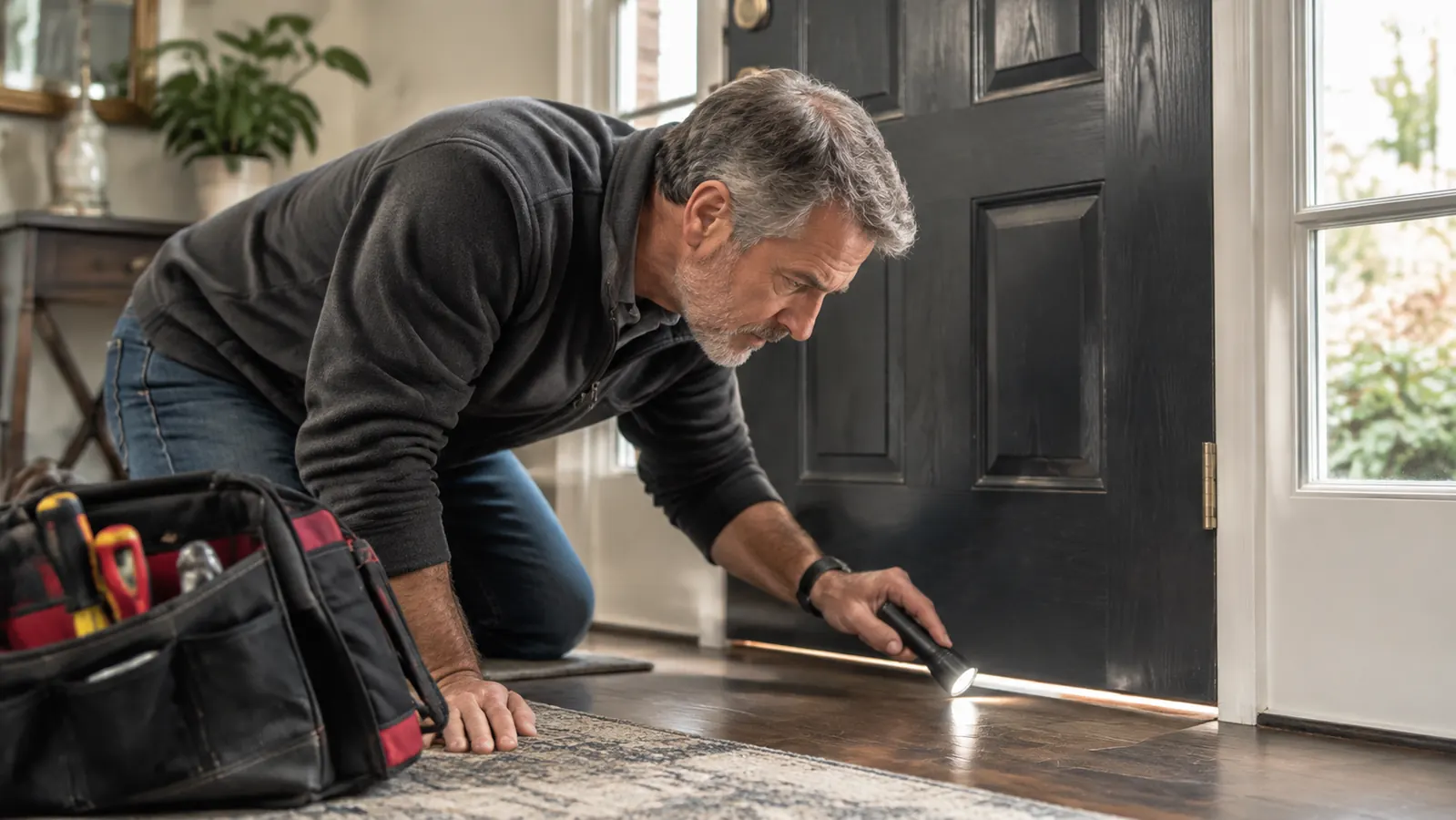
So measure before you order. A ruler works, a stack of coins works, a folded piece of cardboard works. Do it at the latch side and at the hinge side, because plenty of doors are not hung square and the gap changes across the width. On my front door the number was three quarters at the strike side and seven eighths at the hinge side, and the wedge behaved better when I pushed it toward the hinge, where the door travels down furthest.
I measured every door in the house that same weekend, because a number on a notepad beats a hunch. Front door: three quarters at the strike, seven eighths at the hinge. Basement door at the top of the stairs: five eighths, right at the edge of the band. Garage entry: an inch and a quarter, which is too much, and the wedge slid straight under without the door ever touching it. Back door: three quarters, but the door sags and rubs the sill, which is a different problem and gets its own paragraph above.
If your number comes back at an inch and a quarter, no amount of adjusting will save it. The door has to come down on the wedge. A door with that much clearance goes right over the top of it, and what you have bought is a paperweight with a siren in it.
Floor surface matters nearly as much. The non-skid pad on the bottom grips hardwood and tile well. On a thick pile rug the wedge compresses into the carpet, the door has to travel further before it bites, and on a slick mat the unit will skate instead of hold. If your door opens onto a runner in a hallway, test the placement in daylight before you trust it with anything that matters.
Measure twice at the hinge side, then order once
SABRE rates this wedge for doors with roughly a 7/8 inch gap at the floor. If your measurement lands there, the alarm will do exactly what the listing says it does.
Amazon See the SABRE Door Stop Alarm on Amazon →What 120 dB Sounds Like in a Hallway
120 dB is loud the way a smoke alarm is loud when you are standing directly under it. It is not a sound you sleep through and it is not a sound you stand beside for a minute and feel fine about afterwards. In my upstairs hallway it bounced off the plaster and came back at me. If you test it, do it at arm's length rather than beside your ear, and warn the person in the next room first, because they will not enjoy the surprise.
I learned that the hard way in the kitchen, with Carol's sister visiting. I set it off beside my own knee at about eight in the morning and she came down the stairs at a jog convinced the furnace had blown. Nobody was hurt and I have not repeated it. Test the unit once when it arrives, confirm the battery is good, then put it on the floor and leave it alone. These are not devices you demonstrate at parties.
Two things worth knowing about the number itself. A normal conversation sits near 60 dB and a vacuum cleaner closer to 70, so 120 is not twice as loud as either, it is a large multiple, and your ears will confirm it. And a decibel rating measured in open air is not a decibel rating in a hallway, because sound bounces off hard surfaces, gets swallowed by carpet and drapes, and stops at a closed door.
SABRE rates the alarm as audible up to 600 feet. Treat that as the best case, on a still night, with the windows open and nothing between you and it. What I can tell you is that it carried through a closed bedroom door and over a radio at reasonable volume. Whether your neighbor three houses down hears it depends on their windows, their air conditioning and how deeply they sleep. Do not buy it expecting the block to come running.
The thing it will not do is tell anyone. There is no monitoring, no phone alert, no call to a service, no message to your daughter in Cincinnati. The wedge makes noise and the noise is the entire product. If a notification on your phone is what you actually want, this is the wrong shelf in the wrong aisle.
A wedge alarm does not lock a door. It buys you a few seconds of noise and gives a neighbor a reason to look out the window, and that is the whole promise.
What Nobody Tells You Before You Buy One
It is not a barricade. The unit weighs 4.8 ounces and the non-skid pad is there to keep it from sliding on its own, not to hold a door shut against a person. A hard kick will move it, and the door will open, with the alarm screaming the whole time. I tried it myself with a work boot, gently, at the basement landing. The wedge skated about six inches, the alarm went off, and the door opened. Nothing broke, and nothing was supposed to break. That is still worth something, since noise is what most opportunistic thieves are trying to avoid, but do not buy this thinking your door is now reinforced. It is a warning, not a lock.
It covers one door. If you want the back door, the garage entry and the basement covered, you need one per door, and you need to remember to set each one every night. I moved mine around for a month and twice left it in the wrong doorway because I was carrying groceries and thinking about something else. A device that depends on a nightly habit is only as reliable as the habit.
There is a habit cost in the other direction too. In the first week I caught the wedge with my foot twice while carrying firewood in from the garage, and once I set it off at six in the morning by nudging it while hauling a box down to the basement. A house with a dog, a toddler or a teenager coming in late will find that wedge with a foot, and the whole street will hear about it. Carol's fix was a small hook on the inside of the hall closet so the thing has a home when it is not in a door. Ten minutes and a screwdriver, and the accidental triggers dropped to nearly nothing.
It is also not discreet. The wedge sits in the doorway where anyone looking through a window can see it. Some people will count that as a plus, since a visible alarm does part of the work on its own. Some will not want a wedge in the front hall when the in laws visit. That is a taste question, not a security question, but it is worth deciding before you order.
The Battery Compartment Is the Weak Point
The alarm runs on one 9 volt alkaline battery, and getting into the compartment takes a small screwdriver. That is a deliberate choice, since a screw keeps a curious child from opening the door and scattering the battery across the hall, but it also means you should keep that screwdriver in a kitchen drawer rather than the toolbox out in the garage. On the evening the battery dies you will want it within reach, not two rooms and a flight of stairs away.
There is a low battery indicator, which is the only reason I am not more annoyed about the screw. Without an indicator you would find out the unit was dead by testing it, and nobody tests a door wedge every week. Check the light when you change the clocks in spring and fall and you will stay ahead of it.
SABRE backs the unit with a 90 day limited warranty, which is short for something that lives on the floor and gets stepped on. Read it before the box goes out with the recycling, because that window closes quickly, and the wedge is exactly the kind of product that gets bought, forgotten, and then needed.
I cannot give you an honest battery life figure, because I have not run one flat yet and I am not going to guess. Ask me after a winter in a drafty front hall. The low battery indicator is how you will find out, and that is the honest answer.
What I Liked
- Sounds at 120 dB and carries through a closed door and a radio
- Runs on one 9 volt battery with no wiring and no installation
- Non-skid pad holds on hardwood and tile
- Low battery indicator keeps you from discovering a dead unit too late
- Small and light enough to pack for a hotel or a dorm room
Where It Falls Short
- Only works on doors with a gap close to the 7/8 inch spec
- A hard kick moves it, so it warns rather than blocks
- Battery compartment needs a small screwdriver to open
- One alarm protects one door, and only if you remember to set it
- 90 day limited warranty is short for a floor duty product
Who This Is For
Renters who cannot change a lock and want a second layer at a bedroom door or the front door. Travelers who want something for a hotel room that takes up less space in a bag than a paperback. Anyone with an inward swinging door, a gap in the right range and a deadbolt already in place who wants noise to go with it. In my own house it has earned a spot on the shelf by the front door, and I will keep setting it on nights when Carol is home alone.
Who Should Skip It
Skip it if your door swings out, if the gap measures under half an inch or over an inch, or if the door opens onto thick carpet that swallows the wedge. Skip it if the front door is your only way in and you want an actual barrier, because a door security bar or a properly anchored strike plate is the right tool for that job. And skip it if you want an alert on your phone, because this unit will never send one. Buy the SABRE wedge for what it is, a loud warning under a door, and you will get your money's worth.
A loud wedge under the door beats a quiet hallway
Check the gap, load one 9 volt battery, and you have 120 dB of noise pointed at anyone who leans on the door. That is the deal SABRE is offering, and it is a fair one.
Amazon See the SABRE Door Stop Alarm on Amazon →