
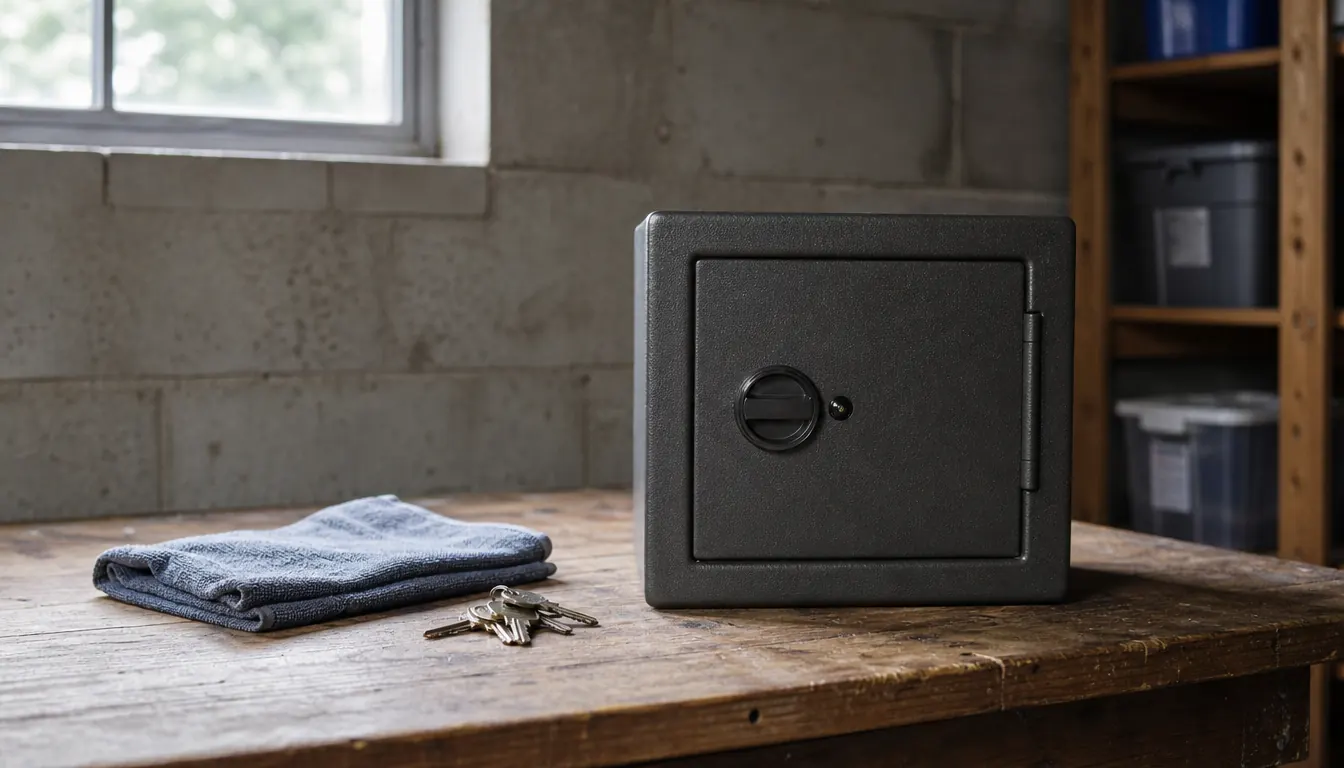
I have opened a lot of small home safes for people who could not get into them. That is the part of a locksmith's work nobody pictures. No drama, just a homeowner in a driveway holding a safe under one arm, asking whether I can get it open without ruining the finish. So when a TIGERKING biometric safe arrived at my house to be looked over, I did not start with the carton or the brochure. I set it on the basement bench, closed the door, and asked the only question that matters to me. How would I get into this if the electronics quit on a Sunday night?
Here is the short answer, and then the long one. The TIGERKING 20 lb biometric safe is a compact locking box for passports, cash, deeds and small jewelry. For that job it is well built and the fingerprint reader works. It is also not a burglary safe and it is not a fire safe, and a fingerprint reader does not change either of those facts. Most of what I want to say sits in that gap, between what a biometric safe appears to do and what it actually does when something goes wrong.
The Quick Verdict
A well-made small safe with a fingerprint reader that actually works and two backup ways in that do not depend on electronics. Buy it for documents and small valuables bolted to a shelf or floor, not for a house fire and not for a determined burglar with tools.
Amazon Check Today's Price →Check the current TIGERKING price and read the full spec sheet before you order
The listing carries the door thickness, the bolt size, the mounting hardware and the exterior dimensions. Those are the numbers that decide whether this safe fits your closet and your job.
Amazon See Today's Price on Amazon →How I Actually Inspected It
The safe came out of the carton at 20 pounds, light enough to carry under one arm and heavy enough that you notice it. I put it on the bench and went over it the way I would go over any lock I was asked to service. I read the door, the bolts, the hinge side, the pre-drilled holes on the back and the bottom, and the seam where the door meets the body. Then I set it up and lived with it for three weeks, first in the bedroom closet and then bolted to the shelf framing in the garage, before I formed an opinion worth printing.
Setup day was a Tuesday in October. The carton showed up on the porch and I carried it down to the bench in one hand, which tells you the first thing you need to know. Before I read a single page of the manual I put a level on the top plate and ran a straightedge along the door seam, because a warped body shows up there first and no lock will fix a bent frame. It was flat. Then I opened and closed the door twenty times in a row and counted the ones that needed a second push. None did.
I want to be plain about what this review is and is not. I did not attack it with a pry bar, and I did not put it in a fire. I am not going to pretend otherwise. What I can tell you is how the lock behaves, how the body is put together, what the mounting hardware is worth, and where the design gives a thief an easier path than you would expect. That is the useful half of a safe review and it is the half most listings skip straight past.
One more thing before the details. The interior is a single compartment with a removable shelf, and the exterior is listed at 9.9 inches deep by 13.8 inches wide by 9.9 inches high, with 1.2 cubic feet given as the capacity. Read those numbers as a description of the box, then go measure the shelf you had in mind. A safe that does not fit where you meant to bolt it becomes a safe that sits loose on a closet floor, which is the worst place for a light safe to end up.
The Fingerprint Reader: Where It Works and Where It Cannot Help
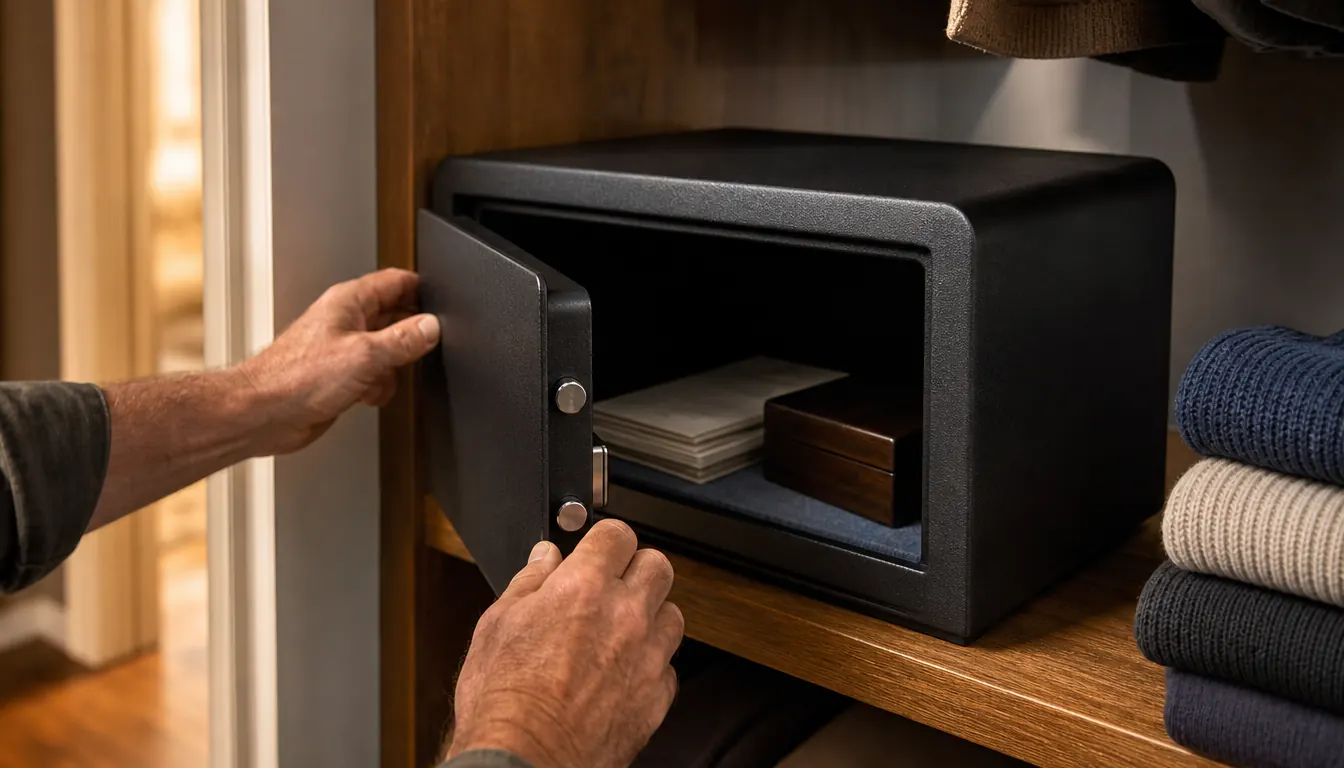
The fingerprint reader is why most people buy this safe, so it deserves a straight description. You enroll a finger once, the safe stores the print, and after that you press the finger to the reader and the door opens. In three weeks of daily use it never failed on me. That surprised me, because budget readers usually demand a very particular placement of the finger, and this one took my thumb at slightly different angles without complaint. Cold mornings in the garage did not change that.
I enrolled both thumbs and my right index finger, three prints in all, and then tried each one wet, dry and after a morning of yard work. Dry hands read on the first press. Damp hands off a cold water glass read on the first press too. The one miss I got all month came after I had been handling firewood, and the reader wanted a wipe with my shirt and a second press. Carol has smaller hands and thinner skin, and she had to press her thumb a little flatter than I did, but it read her fine.
What the reader cannot do is know who is standing in front of it. A fingerprint is not private the way a combination is private. It is a thing you leave on door handles, on drinking glasses, on the counter beside the sink. Any lock that reads a print can be fooled by a good copy of that print, and the reader on a small home safe is not built to tell the difference. That is not a knock on TIGERKING. It is how the technology works at this size and this class. Treat the reader as convenience, and treat the backup combination and the two emergency keys as the security.
Which is why I want you to do one thing the day the safe arrives, before anything goes inside it. Open the door, take out the two emergency keys, and put them somewhere outside the safe and outside the room. Not taped to the back. Not in the drawer underneath. I have been called out for this exact problem more than once, and it is always the same story. A dead reader, a key locked inside, and a safe that has to be drilled because nobody thought about it on the day it was set up.
Twenty Pounds, a 50 mm Door and Two 25 mm Bolts
The door is where the money went. The listing gives a 50 mm door construction and two 25 mm locking bolts in an alloy steel body. In plain terms, the door is thicker than you would expect on a box this size, and the bolts are the steel pins that slide into the frame when you shut it. Two bolts means one on each side of the door. That is normal at this size and adequate for the work, though you will see safes with bolts on three sides. More bolts is better. Two is not nothing.
What I liked was the tolerance. There is almost no play in the door once it is shut and locked. On cheap safes you can often rock the door a quarter inch and see daylight at a corner, and that gap is where a pry bar gets its first bite. This one closes tight and stays tight, and the 20 pound body has no rattle to it when you thump it.
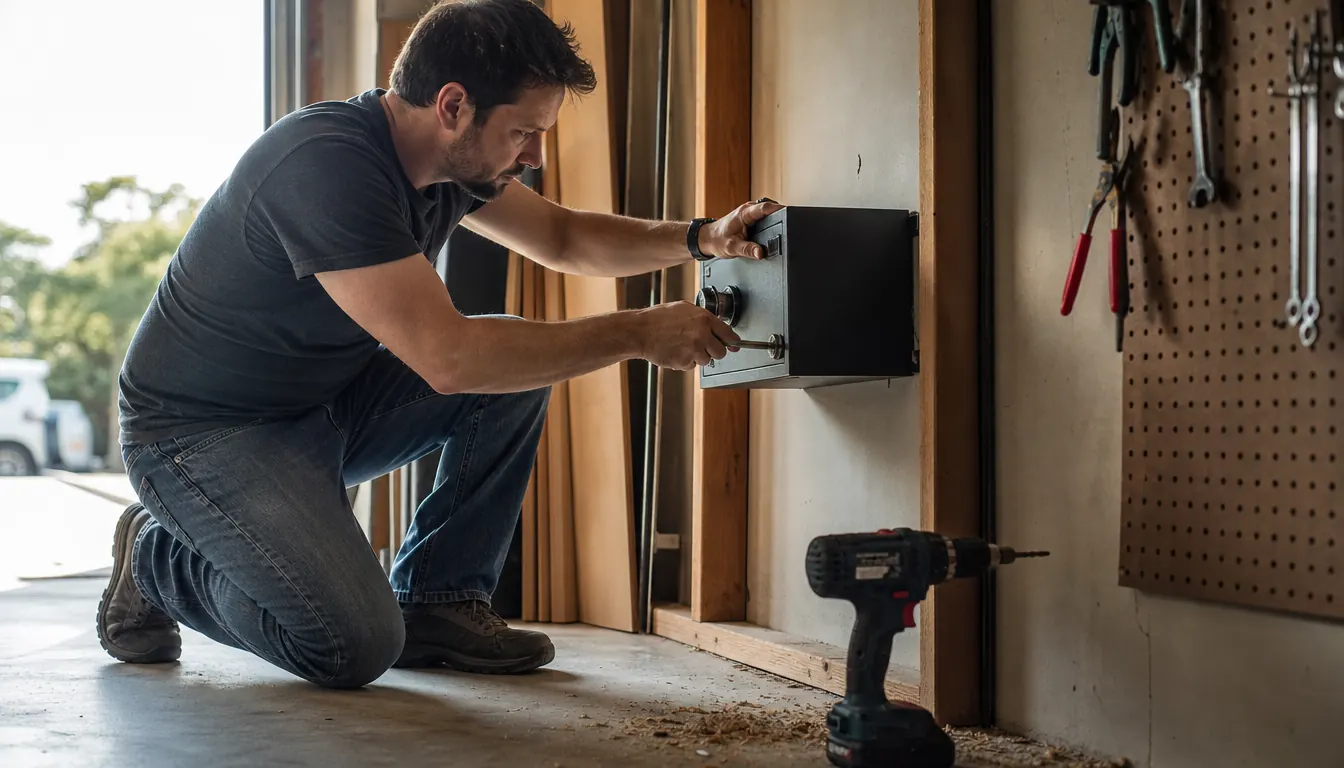
What I did not like is the weight itself. Twenty pounds is a box, and a box is easy to pick up and walk out with. Everything else in this review depends on you mounting it. The back and the bottom are pre-drilled, and four expansion bolts come in the carton along with the manual. Use them. Put it through a floor joist or into a wall stud, never into drywall and never onto a loose shelf. I bolted mine into the garage shelf framing and it took about twenty minutes with a socket wrench. That is the twenty minutes that turns this from a carrying case into a safe.
One note on the mounting, because it is where people get into trouble and where I nearly did. My first plan was the wall above the garage shelf, and the stud finder put a stud about an inch left of where I wanted the safe centered. Two of the four bolts would have landed in hollow drywall with nothing behind them but the paper face and a half inch of gypsum. A bolt in drywall holds until it does not, and when it lets go the safe goes with it. I moved the safe onto the shelf framing and drove all four bolts into solid wood instead.
Twenty pounds of alloy steel is not much against a man with a pry bar. Twenty pounds bolted through framing with four expansion bolts is a different conversation entirely.
The Vibration Alarm, the Backup Combination and the Two Emergency Keys
The safe has a vibration alarm, and it does what the name says. Knock the body or drop it and the alarm sounds. It is not a monitored alarm, it does not call anyone, and it will not stop somebody who is committed to the job. What it does is make noise, which is the one thing a burglar inside a quiet house does not want. Paired with the mounting bolts, it is about as much resistance as a box at this level can honestly offer.
The backup combination is the feature I would set up first if the safe held anything I would be sore about losing for a week. It does not care about a battery or a dry thumb. The two emergency keys work the same way, which is the reason I told you to walk them out of the room on day one. Three ways in, and two of them do not depend on electricity.
I tested the alarm on purpose and by accident. On purpose, I tapped the door with the handle of a screwdriver and it went off on the second tap. By accident, I set the safe down on the bench harder than I meant to at the end of a long afternoon and it went off then too. I set the combination the day it arrived and then left it alone for a week to see whether muscle memory would hold. It did, which matters, because in a hurry you will not be reading anything off a card.
Now the part that matters more than any of it. This safe is not fire rated. There is no fire rating on the listing and none on the box. Papers in an unrated container in a house fire do not survive, and I have seen the aftermath on more than one call. If the documents in your house would be hard to replace, a fire rating matters more than a fingerprint reader, and this safe does not have one. That is not a flaw in the product. It is simply what the product is.
The Things That Annoyed Me
Three complaints, and none of them are deal breakers, but you should hear them before you order. The first is the interior. One compartment and a removable shelf is fine for papers, cash and a jewelry box, and awkward for anything tall. If you plan to store a standing document folder, you will be lifting the shelf out every time you want it, and there is no middle setting between shelf in and shelf out.
The second is that 1.2 cubic feet fills faster than people expect. Folders are bulky. A stack of tax records, the deed folder, the passport wallet and Carol's mother's rings in a box will take up more of that shelf than you picture when you read the number. Buy for what you own plus a third, not for what you own today.
The third is the alarm sensitivity. Set the safe down a little firmly on the bench and you will hear it. That is the trade for it being sensitive enough to be worth having, and I would rather have it this way than have it sleep through a real knock, but it will surprise you the first two or three times.
What I Liked
- Fingerprint reader opened on the first press every time across three weeks of daily use, including in a cold garage
- Tight door fit with a 50 mm door construction and two 25 mm locking bolts, with almost no play to start a pry bar
- Vibration alarm adds noise resistance, which is the part of home security burglars actually dislike
- Pre-drilled back and bottom with four expansion bolts and a manual in the carton
- Backup combination plus two emergency keys give three ways in, two of which ignore the electronics
- Removable shelf keeps papers and small valuables from becoming one pile
Where It Falls Short
- 20 pounds means it protects nothing until you bolt it down, and that is on you, not the safe
- No fire rating, so documents are not protected from a house fire
- 1.2 cubic feet and one compartment fill up quickly, and tall items fight the shelf
- Vibration alarm is sensitive enough to trip on a firm set-down
- Compact exterior limits what you can store more than the capacity number suggests
Size, Capacity and Where It Actually Fits
The exterior runs 9.9 inches deep, 13.8 inches wide and 9.9 inches high, and the safe weighs 20 pounds. Those numbers put it on a closet shelf, a garage shelf or the floor of a bottom drawer run. It will not hold a long gun, a full file box or a laptop with room to spare. What it holds is a stack of papers, the passports, a couple of jewelry boxes, cash and a few small keepsakes, which is what most households actually put in a safe.
Where to put it is a decision worth making before it arrives, not after. Carol and I keep our papers on the second floor, so the safe lives in the bedroom closet where we can reach it without a trip to the basement. I moved it to the garage for a week to test the reader in the cold, and it behaved. I would still not leave documents in an unheated Ohio garage through a winter, because condensation does not care how good the lock is and paper does not forgive it.
Who This Is For
This is the right safe if you want a small, solid box for passports, cash, deeds and family jewelry, bolted into a shelf or a floor, opening in a second on a fingerprint. It suits a renter who cannot cut into a wall but can drive four bolts into a closet floor or a shelf frame and patch the holes on moving day. It also suits anyone who has been keeping documents in a shoebox on the top shelf of a closet, which is where most of the papers I get asked about actually live.
Who Should Skip It
Skip it if you want fire protection, because it has none. Skip it if you want a safe that resists a determined burglar with tools, because a 20 pound box does not, however well you bolt it. Skip it if you need to store a rifle or a full file box. And skip it if you are not going to mount it, because an unbolted TIGERKING safe is a locked carrying case, and a thief will treat it exactly that way.
If the fingerprint, the backup combination and the four mounting bolts sound like the right setup, here is the current price
Read the dimensions against your shelf first, then check today's price. The safe earns its keep bolted down, so have the drill and the socket wrench ready before it lands.
Amazon Check Today's Price on Amazon →